
 For the best audiobook experience, use ElevenReader
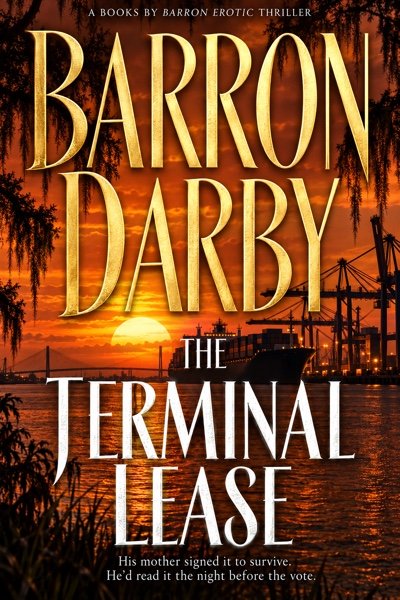
The Terminal Lease
His mother signed it to survive. He read it the night before the vote. She read every word of her life until the night she did not.
Written by Barron Darby
Ebook · Books By Barron
Odalys Cabral has read every word of every document she has ever put her name to. Her father taught her that at a kitchen table in Pooler with his hands split open from a twelve hour hatch, and it made her the youngest real estate counsel the Savannah port authority has ever hired and the first woman they let write a lease the size of the Santangelo ground lease.
The night before the board advertises that renewal, Nico Santangelo puts a single page in front of her and covers it with his hand. Forty days, the length of the public comment period. She says out loud what she wants and he gives it to her, and on the forty first day she walks out of his house with whatever she asked for. She signs it without reading one line.
Underneath the lease there is a rider nobody filed, forty years old, paying a monthly sum to a trust with a number instead of a name. Odalys finds her own last name on a wire confirmation in his desk drawer and puts it back and gets into his bed anyway. By the time she understands what the page she signed actually did, the money has stopped, a polite man has sat in her father’s kitchen and would not take coffee, and the whole city is on the apron watching a priest bless a new berth.
She can be the woman who reads it, or she can be the one who gets asked about it under oath.
Crime erotic thriller. Explicit throughout. Adults only.
Chapter One
▶ TAP TO PLAY CHAPTER ONEChapter one is read by Jessica Anne Bogart. To hear the rest, buy the eBook, open the EPUB in the free ElevenReader app, and pick a voice. The whole story, read to you.
Did chapter one make you want chapter two?
This comes straight to me. No account, no purchase, nothing posted publicly.
I had read every word of every document I ever put my name to, and the night Nico Santangelo put a pen in my hand I signed a page without reading one line of it, with his mouth an inch off my ear and the whole port burning orange through the glass behind him.
That is a fact about me and not a confession. My daddy taught me to read before he taught me to swim. I was in a man’s office at an hour when the cleaners had already come and gone, with the renewal draft in my bag and my shoes still on, and I signed a page I had not read, and I knew I was doing it while I did it.
The building sits on Bay with its back to the river, and the top floor is one room with a desk in it and nothing on the walls. You can see the whole terminal from that glass. Four cranes lit up white, the stacks going blue and rust and blue, a ship under the hooks with her deck lights on, and the water carrying all of it twice. The marsh was out there somewhere doing what it does at low tide. The air conditioning had been off a while and the room held the day in it.
“Counsel.” He came around the desk with two glasses and the bottle already open. “You walked.”
“I parked at the authority. It’s four blocks.” I put my bag down. “I’m not fragile, Mr. Santangelo.”
“Nobody said fragile.” He poured mine first, then his, and he did not look at either glass while he did it. “Hot, though.”
“It’s the hot weeks. It’s supposed to be hot.”
“Sit down, counsel.”
“I’ll stand a minute.” I did not sit down, and I did not say why, which was that I had been in a conference room since lunch with the general counsel and two men from the authority’s finance side, and all three of them had spent the afternoon telling me what my own draft said. “The board advertises in the morning. Forty days of public comment, then they vote. There’s nothing left for you and me to do tonight, which you know, because I sent you the memo.”
“I read the memo.” He touched the paper on the desk without turning it around. “Read this one.”
I looked down and my stomach did something I did not care for.
It was not my draft. Mine was eleven pages bound at the corner in the authority’s blue, and this was loose and old and the top sheet had gone the color of weak tea. GROUND LEASE, HUTCHINSON ISLAND BERTH, TERM OF FORTY YEARS. The typeface was a typewriter’s. Somebody had made a wet ring on it with a glass a long time ago and never moved the glass.
“That’s the original,” I murmured, and I did sit down then. “Where did you get this?”
“My mother’s house. It’s been in a drawer in her kitchen under the takeout menus since before I could reach the drawer.” He sat on the edge of the desk, which put him above me, and I let him have it. “You’ve seen the authority’s copy.”
“I’ve read the authority’s copy twice.”
“Then tell me how many pages are in it.”
“Forty-one with the exhibits.” My finger was already moving under the line of the thing on his desk, which is a habit I have had since law school and have never once been able to stop. “Why?”
“Because this one is forty-two.”
I turned the last sheet over.
It was a single page. Not an exhibit, not a schedule, not anything carrying a number in the same hand as the rest. A rider, executed the same day, incorporated by reference into the body of the lease, and underneath all of that a payment instruction to a trust that had a number instead of a name. The signature at the bottom was a woman’s, careful the way handwriting is careful when a person has practiced it, and made by somebody holding the pen too tight.
“Rosalia Santangelo,” I read off it.
“That’s my mother.”
“I know whose mother she is.” The paper was dry and it had that smell old paper has, like a closed room. “This is a rider nobody has filed. Not with the authority, not with the clerk, not with anybody. It’s forty years old and it pays out monthly and it has been paying out monthly the whole time, hasn’t it.”
“Every month.” He drank about half of his. “Since the winter my father was found.”
He put that out like a man reading a berth number off a board, and I watched his face while he did, and his face did not do anything at all, which told me more than a crying man would have.
“Nico.” It was the first time I had used it and I heard myself do it. “If I take this to the board in the morning, the renewal doesn’t get advertised. It gets referred. You lose the berth for a year while three committees read a page your mother signed when you were three years old, and I can promise you what the paper writes on day two.”
“I know what the paper writes.”
“Then why am I holding it?”
“Because you’d have found it.” He set his glass down behind him without looking. “You pulled my family’s file three weeks before you met me.”
The room got very quiet. The cranes kept going outside, the way they do all night, and one of them put a box down on the stack and the sound came through the glass a beat late.
“That’s in the system,” I managed.
“It’s in the system.” He agreed with me pleasantly, which was worse. “Twice, counsel. You opened it twice.”
“Diligence.”
“Say that again with your chin up and I might believe it.”
I did not say it again.
What I did was put the rider down flat on his desk and square it with two fingers, because my hands wanted a job, and I asked him, “Why did you come to my office six weeks ago?”
“To look at you.”
“That’s not an answer to a question. That’s an answer to a different question.”
“It’s the only one I’ve got that’s true.” He reached past me and put his hand flat on the rider, covering it, and left it there. “In the morning you’re going to stand up in front of that board and say the renewal is clean. And it is clean. The body of the lease is clean, the rent is market, the insurance is current, and the thing in your hand gets struck at renewal without reopening one word of the rest of it, which you already know, because you wrote the clause that lets me do it.”
“I wrote that clause for a parking easement.”
“You wrote it well.” He took his hand off the paper. “That’s tomorrow. Tonight there’s a different page.”
And he set it down where my hands were.
One sheet. Clean white, printed that day, nothing on it but about a paragraph of type and a line at the bottom. I saw my own name in the first line, all three of them, the way it goes on something that matters, and my eyes went to the second line the way they have gone to the second line of everything in my life.
He put his hand over it.
“Forty days.” He had come off the desk and he was standing at my shoulder, and his voice had dropped into a place where he did not need any volume at all. “The length of the comment period. Not at work. At work you’re counsel and I’m the operator and neither of us knows the other one’s first name. Everywhere else you’re mine. You say out loud what you want, and I give it to you, and on the forty-first day you walk out of my house with whatever you asked for and you never have to see me again.”
“You’re going to have to let me read it.”
“No.”
“Nico.”
“No.” He put the pen down on the desk beside my hand, a heavy one, the kind men buy themselves. “Sign it.”
And here is the part I have never been able to put to anybody since.
I have been the person in the room who read it since I was nine years old. It is a job. Nobody wants you for it. They want you for it at four in the afternoon when there’s a problem and then they go home to somebody who wants them for something else, and I had never one time in my life been the thing a man could not stop thinking about, and I was thirty-four years old with a pen in my hand and a man’s breath on the side of my neck telling me to sign something I had not read.
“Put your hand on it,” I whispered.
“It is on it.”
“Not the paper.”
He got it then. He laughed, low, about two notes of it, and he got one hand flat on my stomach through the silk and the other one up under my hair at the back of my neck, and he did not move either of them, and he told me, “Sign it, Odalys,” and I signed it.
My handwriting came out wrong. I have signed my name maybe forty thousand times and it has looked the same since I was twenty, and that one came out loose and dropping off to the right like somebody else’s, and I was still looking at it when he took my glasses off.
I put my hand up on instinct. He caught it.
“No,” he murmured, and he folded them and set them down on the rider, and the whole room went soft at the edges the way it does, the cranes going to four smears of white, the stacks to nothing, the river to a wide dark thing with lights dragged across it. I have not let a man see my face without them in daylight since college. It was not daylight. That is the deal I had been making with myself for about fifteen years and I had never once put it into words, and he had taken them off me in under a minute without asking, and I was so angry about it that it took me a second to understand what the rest of my body was doing.
“Look at me.”
“I can’t see you.”
“You can see enough.”
I could. A shape, a white shirt open at the throat, the shine of his watch. He took my chin and turned my face up, and then he just looked at it, for long enough that the air conditioner came on somewhere under the floor and a tug put its horn out on the river and I heard my own breath go.
“Say something,” I whispered.
“You’ve got a freckle under your left eye that the glasses sit on.”
“That’s what you’ve got?”
“I’ve been looking at it for six weeks.”
I came up out of that chair and got a fist in the front of his shirt, and he was already there, and his mouth was hot and he tasted like the whisky and the stubble went all the way up my cheek, and he got both hands down and lifted me, and I am five foot nine with everything God gave me and he lifted me like I did not weigh a thing, and the backs of my thighs hit the edge of that desk. Forty-two pages went off it onto the floor behind me. I heard them go. I did not turn around.
“The lease,” I got out.
“It’s been in a drawer under the menus for forty years, counsel. It’ll keep till morning.”
He got my skirt up over my hips with both hands and then stopped, with his hands right there on the tops of my thighs and his forehead down against mine, and the stopping was worse than anything he had done so far.
“Tell me what you want.”
“Nico.”
“Out loud. In the room.” His thumbs were going in slow circles on the inside of my legs and the whole of me had gone liquid from the waist down and the air off the vent was running cold across the wet of my mouth where he had been. “That’s the whole deal. That’s the only thing on the page. You say it and you get it.”
“I don’t say things like that.”
“I know you don’t.”
“I’ve never said one thing like that out loud in my life.”
“I know.” His mouth came down on the side of my neck, under the jaw, and he stayed there, and he spoke into my skin so that I felt the shape of every word go down through my chest. “That’s what the forty days are for.”
So I said it, badly and too fast and with my face hot and my hands in his hair and my eyes shut, and I used the words I think in and not the words I bill in, and I told him I wanted his hand in my pussy and his mouth on me and I wanted it right there on that desk with the port in the window, and when it was out of me he made a sound against my throat like a man who had been waiting on it a lot longer than six weeks, and then his hand went where I had put it.
I had my palm flat on the desk and the other one holding the back of his neck and my head tipped back far enough to see the ceiling, and the room went warm and then warmer, and his mouth came off my neck and went down, and he did not rush one minute of any of it, and he talked the whole way through, filthy and specific, in that same flat voice he uses to tell a man where to set a box.
He got my blouse open and my bra up and his mouth on my tits, one and then the other, and he told me what he’d been thinking about in a meeting three weeks ago while I sat across a table from him reading out a rent schedule, and I had my fingers in his hair and I was laughing and then I wasn’t laughing.
“You were wearing the cream one,” he murmured into me.
“I don’t own a cream one.”
“You do. You had it on the day you made Terrence read the insurance certificate out loud to the room.”
“That’s a terrible memory to have about a woman.”
“It isn’t the memory I’ve got.” He came back up and got his mouth near mine without putting it there, which he’d been doing all night and which I was about to start screaming about. “Ask me for something else.”
“I’m not good at this part.”
“You’re doing fine.”
“That’s a lawyer’s compliment and I invented it.”
“Then ask me badly,” he told me, and I did, and he laughed against my mouth and then he quit laughing and got down on his knees on the whisky and the lease and put his mouth on me there, with my heels on his shoulders and his hands up under my ass holding me on the edge of that desk, and I went up off it and he put one forearm across my hips and held me down, and nobody had held me down since before my mother got sick, and I had not known until that second that I wanted it.
It came in sideways and slow and it would not quit. I had that big heavy pen somewhere under my shoulder blade and a ship outside dropping steel on steel every few seconds and my own blood going in my ears louder than the ship, and while he was doing it, with my eyes shut and my mouth open and nothing coming out of me, my head went where it goes.
A kitchen table in Pooler. My father with his hands split open from a twelve-hour hatch, a pen and a union contract and the radio turned down, reading every line out loud while my mother put rice down around the paper.
Don’t sign nothing you ain’t read, filha.
I came with his name in my mouth and the bridge lights going across the ceiling of a room I had never been in before, and then he came up off his knees and got his belt open and my hand was on his dick while he was still working it free, thick and hot and jumping against my palm, and he swore into my hair, and the swearing wasn’t for my benefit.
“Say the rest of it,” he rasped.
“I already said it.”
“Say the part you cut off.”
So I told him the rest, with my fist still moving and my mouth at his ear, and his whole weight came forward onto me and his breath went ragged against my collarbone, and that was the first time I understood I could do something to him too.
Afterward neither one of us said anything soft. He picked my glasses up off the rider and cleaned them on the tail of his shirt and handed them over, and I put them on, and the room came back hard and bright and full of edges. There was whisky on the floor and a lease all over it. He crouched down and started squaring it page by page, on his knees in a four-thousand-dollar suit.
“The board’s at eight,” I told him.
“I know when the board is.”
“I’m going to say it’s clean.”
“It is clean.” He did not look up. “Go home, Odalys.”
I got down two flights before I remembered I had never asked him for the page.
Tamsin answered on the first ring, which she does at any hour, and she was talking before I had the phone all the way up.
“Oh, so you’re alive. I called you at seven, I called you at eight, and then I said to myself, you know what, that woman is in a conference room arguing about a parking lot, let her live.”
“It wasn’t a parking lot.”
“Mm.” There was a long pause with a television in it, and then there was no television. “Odalys Cabral. Where are you.”
“Bay Street.”
“Bay Street?” She let that sit. “Walking which direction, baby?”
“Toward my car.”
“From where.”
I got maybe four steps.
“Ehn, from where, Odalys.”
“From the Santangelo building,” I admitted, and she screamed, right down the phone, loud enough that a man outside the Pirates’ House looked up at me from forty feet off.
“I knew it. I have been saying it since the first night you came to my house talking about his file is very thorough. Thorough. The man has a courtyard, Odalys. Do you know what a courtyard in that square goes for? That’s not a man, that’s an asset class, and you’ve been in my kitchen three weeks lying to my face about diligence.” She stopped. She has one gear change and this is it. “Was it good?”
“Tamsin.”
“Put that on your mouth. Was it good.”
“I’m not having this conversation on Bay Street.”
“So it was good.” I could hear her moving around her kitchen, the acrylics going on the counter, the fridge, the fridge closing. “Aight. Now be a lawyer for one second, because you know I love you. You’ve got a lease going to that board in the morning and that man is the lessee.”
“I know what he is.”
“Did you sign anything?”
The light changed at Abercorn. I stood there and let it change back.
“Odalys.”
“I signed something,” I told her.
“Okay.” Very calm, which from her is the scariest sound in the world. “What did it say?”
And I stood on that corner with my car thirty feet away and my blouse buttoned wrong under my jacket, and for the first time since I was nine years old I did not have an answer to that question.
Read the rest, or open the EPUB in ElevenReader and keep listening.
Ebook ISBN 979-8-953029-55-1 · Books By Barron