
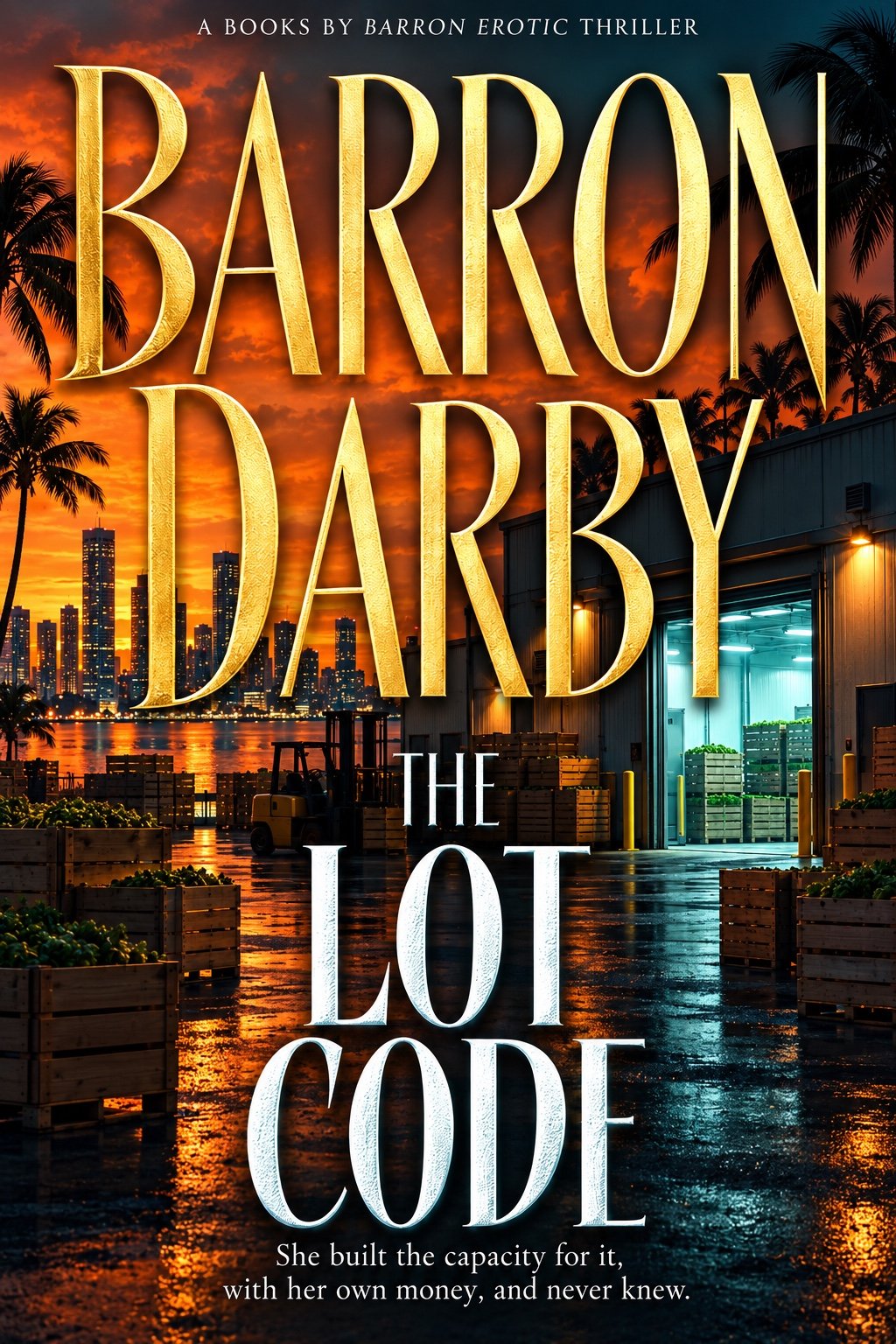
The Lot Code


Payment Secure checkout by Stripe
Pay with Card, Google Pay, Cash App or Link
Format PDF + EPUB, no DRM
About this book
She built the capacity for it, with her own money, and never knew.
Nadège Pierre-Louis has never given a man a dollar. She built a cold-chain tracking company from nothing, sold it for enough to never need anybody, and she can tell you where any crate in Miami is at any hour. What she can't tell you is why she just wired a produce importer six hundred thousand dollars for a cold room.
Dario Montalvo runs Montalvo Fresh, the import house his father built up from a fruit stand on Krome Avenue. He wears white linen in the heat, goes barefoot in the house on Casuarina Concourse, and pours her cafecito before his own. The night her money lands, he doesn't give her his name in bed. He gives her a number: LOT 4729A. Then he shows her the four words on his screen, RECEIVING, HOLD, SHIPPED, CLEARED, and tells her what each one will mean between them.
It's the filthiest game a man has ever played with her, and she can't stop playing it. She can stop reading the building permit she pulled the night before she wired the money, though, and she does. The permit shows a second cold room filed as bonded storage, and that is not what he called it at dinner.
From the Brickell Key balcony she never sits on to the Yellowfin drifting off Elliott Key, from his mother's fruit stand to a pool at the Biltmore where a woman in a wide hat explains, kindly, that her father never lent anyone money in his life, Nadège learns what her lot code really tracks, and who opened it before a single dollar moved.
The Lot Code is an erotic thriller about money, desire and the one thing nobody can steal: a number. It ends with a woman standing up at a family dinner and reading her lot out loud.
A Books By Barron erotic thriller. For adults only.
Chapter One
“If you keep looking at my mouth, you’re going to miss the game.” I kept my eyes on the field, because the scoreboard was easier to look at than he was. “Unless baseball isn’t what you came for.”
“I’ve seen baseball.” He put his forearms on his knees and left the empty seat between us empty. White linen, in that heat—not one mark on it. “Your brother told me you wouldn’t come if he told you I’d be here.”
“My brother tells people whatever fills the seats he already paid for.” I finally looked over. Brown skin, close beard going gray at the jaw, and the kind of shoulders a woman notices before she decides whether she’s allowed to. “What did he tell you about me?”
“That you’d ask me that.” He held his hand across the chair, palm up—waiting for me to decide what to do with it. “Dario Montalvo. I’d have introduced myself at the gate, but you were explaining to him why a parking receipt is not a business expense.”
“Nadège Pierre-Louis. It was the valet tip I objected to.” His hand was warm and dry and easy to let go of, which is why I kept mine in it a beat past polite. “He paid a man to park in a space he could see from where he was standing.”
“Then you’re going to hate my car. I park it myself. I’ll walk past three open spaces to get the right one.”
“That depends on the car, and on what makes a space right, because I’ve watched men walk a quarter mile to keep a door from getting dinged and then leave the windows down in the rain.”
“Nothing next to the driver’s door.” He turned my hand as he gave it back, the way you set something down instead of dropping it. “I don’t like a stranger deciding how far I’m allowed to open it.”
Jean-Marc came back down the row with three drinks held against his chest and the pleased look he gets when he has solved a problem that belonged to somebody else. He put the beer in the empty seat between us like the seat had ordered first.
My brother had been introducing me to his way out of something since he was nineteen. Our mother worked at Jackson and came home and cooked anyway. The two of us learned opposite lessons watching her do it—I learned to count, he learned that somebody always came.
“Good, you met.” He handed me the water and kept the beer for himself. “Nadège, this is my guy. Montalvo Fresh. I’ve told you about him.”
“You’ve told me about several guys, and every one of them needed an introduction to somebody with money, and somehow that somebody was always me.”
“Here we go.” He dropped into the seat and his shoulder cut Dario out of my view entirely. “You’re thirty-three, you sold a company, and now everybody with a business card is trying to get in your purse.”
“Your sister brought a small purse.” Dario didn’t look away from me. “If I wanted her money I’d have to ask her for it directly, and I get the feeling she’d make me explain myself twice.”
I leaned forward until I could see around my brother again. “You could try. You’d get an answer, and you wouldn’t have had to buy him a beer first.”
“I bought my own.” Jean-Marc lifted it as evidence. “Can we watch one inning before y’all start auditing each other, because I paid real money for these seats and I would like to see one ball leave the infield.”
We watched enough of it for him to argue with a call nobody in that stadium could change. Dario let him finish. Then he asked me about Reefer Ledger while my brother explained the strike zone to a man in the next row who had not asked.
“Your alerts caught a reefer failure on one of our loads.” He turned the bottle in his hand. “The driver swore the sensor was bad. Your system had the box warming while the truck sat still.”
“The sensor didn’t know he’d stopped. That part came off the location feed.” I moved my water out of the sun. “Putting those two together was the piece everybody told me nobody would pay for.”
“I paid for it, and we moved the fruit before we lost it, which is the only review that software is ever going to get out of me, so you should take it.”
“Then somebody on your end actually opened the alert. I should have sent flowers.”
“Send them to Yunior. He runs my trucks.” He spoke his cousin’s name the way you speak of family. “He complained about that software every day until the day it saved him, and then he told the room he’d been asking us to buy it all along.”
I laughed loud enough for my brother to look over at me. Dario didn’t look pleased with himself about it—he just watched me finish, which did more damage than pleased ever could.
“You sold to the Atlanta people.” He leaned in on his knees. “Are you still doing the work, or did they let you walk?”
“I walked. I thought walking out was going to be the hard part.” I peeled the wet label off my bottle in one piece and laid it flat on my knee. “Now everybody has a suggestion about what I should build next. Apparently sitting still requires a business plan.”
“What do you like doing?”
“Knowing where things are.” I turned the bottle on my knee. “Making a man admit his expensive problem is a cheap mistake, and then watching him fix it because he can’t stand that I saw it first.”
“That’s work, and you’re good at it, I can hear that in how you tell it.” He turned his head. “What do you like doing when nobody is paying you and you don’t have to be right about anything?”
I thought about inventing something with a beach in it. I had a balcony on Brickell Key and looked at the water through the glass door like it was a screensaver—which is not an answer you give a man on a first conversation. “I’m working on that.”
“Good. You haven’t made yourself a hobby just so you’d have an answer.”
The woman in front of us stood up with a tray and he moved his foot out of her way without looking. I had no business letting that impress me. It did.
Outside, Jean-Marc pointed at his car across the lot and performed a search for his keys that nobody was buying. Dario didn’t help him perform it—he just stood with me while I opened the app.
“Have dinner with me tomorrow. Somewhere we can hear each other and your brother can’t offer to sell you anything.”
“Just dinner?” I looked up from the screen. “You’ve mentioned my company twice. I’m still deciding whether you’re interested in me or in a logistics solution.”
“I’m interested in you. I also have a capacity problem you would understand in about four minutes.” He gave both halves of that the same flat, unhurried attention, like a man reading two true lines off the same page. “I can talk about one of them without pretending the other one isn’t sitting there.”
I canceled the ride before it matched me. “Walk me far enough to show me this car. I want to see what gets a whole parking strategy.”
It sat at the end of a row with nothing beside the driver’s door, black and low, the whole sky laid out across the hood. Nothing about it was asking anybody’s permission to still be here—it just was.
“Grand National.” He patted the roof. “Eighty-seven. It was my father’s.”
“And you drive it.” I walked the front of it with my hands behind my back. “Men with a car like this usually open with why nobody is allowed to sit in it.”
“He bought it to go places. I’m trying to respect his intentions.” He opened the passenger door and stood there holding it. “May I take you home, Nadège?”
I liked that he used the whole name. I liked the question more—nobody had asked me one in a while. “Brickell Key.” I got in before he could decide to help me. “And I’m picking where we eat tomorrow.”
He kept both hands on the wheel while I talked, and he let the quiet sit when I ran out, and by the causeway I’d stopped trying to fill it.
I knew the smell of mangoes on Krome, thick enough that I didn’t need to see a tree. On the water side of the bridge, there was nothing but salt in the air. I liked thinking he knew both places. Maybe I wouldn’t have to explain quite so much.
Shanice answered on speaker while I stood in my kitchen with one shoe off. Something scraped across the floor on her end—a chair, or a man. She sells boats at Dinner Key and she takes furniture damage personally—her own and everybody else’s.
“A man asked me today whether the boat came with the water toys in the photograph.” A door shut behind her. “His own children are in that photograph. Please tell me your night was better than mine.”
“I met somebody, and before you say anything, yes, Jean-Marc introduced us, and no, he didn’t ask me for anything in the same breath, which I noticed because I was waiting for it.”
“Oh, absolutely not.” The scraping stopped. “That is how a story starts when your brother wants to borrow something and doesn’t want to make the call himself.”
“He runs Montalvo Fresh. You know the name?”
“Baby, I sell boats to men who sell fruit, buildings, powder and motivational courses—a company name is not a character reference.” Then her voice came down half a step without losing any of its edge. “What do you like about him?”
“He didn’t ask what I got for Reefer Ledger. He asked what I liked doing.”
“And did you tell him you like correcting people? Give the man the whole picture.”
“I told him I was working on it. He didn’t offer to fix me.” I set my other shoe next to the first one. “He drives his father’s Buick, and he keeps both hands on the wheel when he’s listening.”
“That’s a driving lesson, not a personality, and I have sold boats to men with beautiful hands on the wheel who couldn’t tell you the name of the woman in the next seat.” Somebody called her name on the dock and she covered the phone and gave them an answer I was glad not to hear. “Does he need anything?”
“He has a capacity problem.” I heard it land.
“There it is.”
“He told me out loud, Shanice, before dessert, before anything, and he put it on the table right next to the other thing so I could look at both of them at once.”
“They all put it on the table.” She was moving again. “The good ones put it on the table so you’ll stop looking under it.”
She hung up from a dock somewhere and I stood barefoot in my kitchen, saying capacity problem out loud to nobody, trying to hear whether it sounded like a warning or like an opening.
I picked the restaurant because I wanted to watch him be a guest somewhere I was known. He was better at it than I expected, and he stood when I came to the table. He asked whether I’d eaten, actually eaten, and did not accept the first answer. He ate like a man who’d worked outside at some point in his life and never got over the pleasure of sitting down.
“My father started on Krome Avenue with a fruit stand and a scale he bought used.” He set his fork down. “Mangoes, avocado, papaya. Now it’s forty trucks a week in season and I am out of cold room.”
“How far out?” I asked.
“Far enough that I turn down fruit in August.” He put his fork down. “I can fill a second room the week it opens. I can’t borrow against the building again at a number that leaves anything in it.”
“How much is the room?” I asked, and kept my hands where he could see them.
“Six hundred.” He put it the way you’d call out a weight, with no air around it. “And before you ask, no. I did not bring you here to say that number.”
“You brought me here and the number came.” I pushed my plate to the side. “Those are the same thing in my experience.”
“Then I’ll say the rest of it. I want your money in my business because it’s good money and because you’ll read the agreement, and most people don’t.” He let that sit. “And I want you. Those are two wants. I’m not trading one for the other, and I’m not going to be insulted when you check.”
“I’m going to check.” I told it to the tablecloth, because I had already started.
“Check.” He didn’t blink. “Take a week, take a month, pull the permits if you want, because that is all public and I would rather you find it yourself than hear it from me and wonder what I left out.”
No man had ever handed me the folder before. They wait to see how much of it you’ll open on your own—then they make a face about the part you found.
I pulled the permits. I sat on the balcony I never sit on with the laptop on my knees and I read every page the county had on that building, and the second cold room was permitted, and the use line on it did not say what his mouth had told me at dinner, and I read that line four times and did not pick up the phone.
What I did instead was text him that I wanted to see him.
I had a word for what I was doing, and I kept it behind my teeth. A woman who reads a line four times isn’t confused—she’s choosing which of two true things she’s going to carry, and she’s already put the lighter one down.
He took the long way. The fishermen had the causeway to themselves. He pulled the Buick onto the apron with the water on both sides of us and the city laid out across it like somebody’d set it there to be looked at—then he killed the engine and left the key in it.
“This is where my father parked.” He left the key in. “He’d buy a coffee on the beach side and drive back here to drink it.”
“By himself?”
“By himself, every time, and he never told my mother where he went, and she never asked, because she knew it was the one place he wasn’t working.” He turned in the seat and rested his hand on my knee. “I’ve never brought anybody out here.”
“Say the real sentence.”
“I’ve never wanted to.”
I kissed him. I put my hand on the side of his face and I kissed him. He let me do it, and then he stopped letting me and did it himself—and I pulled him closer.
He had one hand at the back of my neck and the other flat on my thigh, not moving, waiting to be told. I told him. I tucked one knee onto the passenger seat and pulled my dress up past where a dress had any business being on a public causeway, and his hand went exactly where I put it. He breathed my name into my mouth in a voice I had not heard out of him yet. Lower. With none of that patience left anywhere in him.
“Tell me what you want”—his mouth was at my jaw and his voice had dropped out of the range he does business in—“and I’ll do it.”
“Don’t make me say it in a car.” I had a fistful of his shirt and no intention of letting go of it.
“Then say it anywhere”—his fingers had found the edge of everything and stopped there, which was worse—“say it in my kitchen. Say it on my dock. I’ll drive.”
I was almost gone. I was leaning across the console with the windows going white around us, my hand down the front of him, finding out exactly how little of that calm was real. That was when I stopped.
Not because I didn’t want him. I wanted him so badly my ears were ringing.
I stopped because I’d read that permit and kept my mouth shut. If I let him finish what my own hand had started, I’d be a woman who went to bed with a man she’d already decided not to question. My mother had stayed with a man whose money was always on its way—I’d watched her keep paying while he kept promising.
“Take me home.” I spoke it with my mouth still on his, which is not how a woman says it when she means it.
He didn’t argue and he didn’t sulk, and he straightened my dress for me, which should’ve been humiliating and somehow wasn’t. Then he put both hands back on the wheel. His jaw stayed tight the whole way over the bridge. Under my building he gave me “Goodnight,” and nothing else.
I was wet and furious and wide awake, replaying the causeway. He hadn’t asked me for the money or for more of what we’d already started. He’d asked me to tell him what I wanted, then taken his hands off me as soon as I named the one thing that wasn’t it.
My mother always told us she’d stayed because of us. She could keep cooking while she told it, moving something from one pot to another, and I never knew how to answer. He’d taken every dollar of her overtime, and she’d never called it a loan. I’d built my whole life out of not being in that kitchen.
The wire stopped being a question of whether—and started being a question of timing.
When he asked me over, I told him yes. The driveway ran down to the end of Casuarina Concourse and stopped at a house lit warm through open curtains, the water sitting black behind it, a house that did not look to me like it had been paid for in mangoes. He turned the engine off. The Grand National ticks when it cools—it was ticking, and I had my phone out before he got his door open.
“Send me the receiving details again.” I held out my phone. “The business account. I’m not putting six hundred thousand in your pocket.”
“You don’t have to decide out here.” He stayed in his seat with one hand resting on the key. “You can come inside without doing that.”
“I know you’d let me, and I know that’s the point.” I didn’t look up from the screen. “I’m deciding out here anyway, because if I walk into that kitchen first I’m going to decide something else and call it this.”
I checked the name on the account against the name on the company. I checked the amount twice. He watched the house while I did it and gave me a privacy that felt like respect.
The curtains were open and there was nobody behind them. A kitchen light, a lamp in a front room, a house sitting there with the air on for whoever was coming. I thought about my own apartment with the balcony door shut, forty floors of people I’ve never fed—and I pressed send.
I’d never given a man money, though I’d given men every other thing I owned. I sent the wire myself, from my phone, with the engine still ticking, and let my thumb rest on the confirmation. The hard part felt done.
Did chapter one make you want chapter two?
This comes straight to me. No account, no purchase, nothing posted publicly.
“If you keep looking at my mouth, you’re going to miss the game.” I kept my eyes on the field, because the scoreboard was easier to look at than he was. “Unless baseball isn’t what you came for.”
“I’ve seen baseball.” He put his forearms on his knees and left the empty seat between us empty. White linen, in that heat—not one mark on it. “Your brother told me you wouldn’t come if he told you I’d be here.”
“My brother tells people whatever fills the seats he already paid for.” I finally looked over. Brown skin, close beard going gray at the jaw, and the kind of shoulders a woman notices before she decides whether she’s allowed to. “What did he tell you about me?”
“That you’d ask me that.” He held his hand across the chair, palm up—waiting for me to decide what to do with it. “Dario Montalvo. I’d have introduced myself at the gate, but you were explaining to him why a parking receipt is not a business expense.”
“Nadège Pierre-Louis. It was the valet tip I objected to.” His hand was warm and dry and easy to let go of, which is why I kept mine in it a beat past polite. “He paid a man to park in a space he could see from where he was standing.”
“Then you’re going to hate my car. I park it myself. I’ll walk past three open spaces to get the right one.”
“That depends on the car, and on what makes a space right, because I’ve watched men walk a quarter mile to keep a door from getting dinged and then leave the windows down in the rain.”
“Nothing next to the driver’s door.” He turned my hand as he gave it back, the way you set something down instead of dropping it. “I don’t like a stranger deciding how far I’m allowed to open it.”
Jean-Marc came back down the row with three drinks held against his chest and the pleased look he gets when he has solved a problem that belonged to somebody else. He put the beer in the empty seat between us like the seat had ordered first.
My brother had been introducing me to his way out of something since he was nineteen. Our mother worked at Jackson and came home and cooked anyway. The two of us learned opposite lessons watching her do it—I learned to count, he learned that somebody always came.
“Good, you met.” He handed me the water and kept the beer for himself. “Nadège, this is my guy. Montalvo Fresh. I’ve told you about him.”
“You’ve told me about several guys, and every one of them needed an introduction to somebody with money, and somehow that somebody was always me.”
“Here we go.” He dropped into the seat and his shoulder cut Dario out of my view entirely. “You’re thirty-three, you sold a company, and now everybody with a business card is trying to get in your purse.”
“Your sister brought a small purse.” Dario didn’t look away from me. “If I wanted her money I’d have to ask her for it directly, and I get the feeling she’d make me explain myself twice.”
I leaned forward until I could see around my brother again. “You could try. You’d get an answer, and you wouldn’t have had to buy him a beer first.”
“I bought my own.” Jean-Marc lifted it as evidence. “Can we watch one inning before y’all start auditing each other, because I paid real money for these seats and I would like to see one ball leave the infield.”
We watched enough of it for him to argue with a call nobody in that stadium could change. Dario let him finish. Then he asked me about Reefer Ledger while my brother explained the strike zone to a man in the next row who had not asked.
“Your alerts caught a reefer failure on one of our loads.” He turned the bottle in his hand. “The driver swore the sensor was bad. Your system had the box warming while the truck sat still.”
“The sensor didn’t know he’d stopped. That part came off the location feed.” I moved my water out of the sun. “Putting those two together was the piece everybody told me nobody would pay for.”
“I paid for it, and we moved the fruit before we lost it, which is the only review that software is ever going to get out of me, so you should take it.”
“Then somebody on your end actually opened the alert. I should have sent flowers.”
“Send them to Yunior. He runs my trucks.” He spoke his cousin’s name the way you speak of family. “He complained about that software every day until the day it saved him, and then he told the room he’d been asking us to buy it all along.”
I laughed loud enough for my brother to look over at me. Dario didn’t look pleased with himself about it—he just watched me finish, which did more damage than pleased ever could.
“You sold to the Atlanta people.” He leaned in on his knees. “Are you still doing the work, or did they let you walk?”
“I walked. I thought walking out was going to be the hard part.” I peeled the wet label off my bottle in one piece and laid it flat on my knee. “Now everybody has a suggestion about what I should build next. Apparently sitting still requires a business plan.”
“What do you like doing?”
“Knowing where things are.” I turned the bottle on my knee. “Making a man admit his expensive problem is a cheap mistake, and then watching him fix it because he can’t stand that I saw it first.”
“That’s work, and you’re good at it, I can hear that in how you tell it.” He turned his head. “What do you like doing when nobody is paying you and you don’t have to be right about anything?”
I thought about inventing something with a beach in it. I had a balcony on Brickell Key and looked at the water through the glass door like it was a screensaver—which is not an answer you give a man on a first conversation. “I’m working on that.”
“Good. You haven’t made yourself a hobby just so you’d have an answer.”
The woman in front of us stood up with a tray and he moved his foot out of her way without looking. I had no business letting that impress me. It did.
Outside, Jean-Marc pointed at his car across the lot and performed a search for his keys that nobody was buying. Dario didn’t help him perform it—he just stood with me while I opened the app.
“Have dinner with me tomorrow. Somewhere we can hear each other and your brother can’t offer to sell you anything.”
“Just dinner?” I looked up from the screen. “You’ve mentioned my company twice. I’m still deciding whether you’re interested in me or in a logistics solution.”
“I’m interested in you. I also have a capacity problem you would understand in about four minutes.” He gave both halves of that the same flat, unhurried attention, like a man reading two true lines off the same page. “I can talk about one of them without pretending the other one isn’t sitting there.”
I canceled the ride before it matched me. “Walk me far enough to show me this car. I want to see what gets a whole parking strategy.”
It sat at the end of a row with nothing beside the driver’s door, black and low, the whole sky laid out across the hood. Nothing about it was asking anybody’s permission to still be here—it just was.
“Grand National.” He patted the roof. “Eighty-seven. It was my father’s.”
“And you drive it.” I walked the front of it with my hands behind my back. “Men with a car like this usually open with why nobody is allowed to sit in it.”
“He bought it to go places. I’m trying to respect his intentions.” He opened the passenger door and stood there holding it. “May I take you home, Nadège?”
I liked that he used the whole name. I liked the question more—nobody had asked me one in a while. “Brickell Key.” I got in before he could decide to help me. “And I’m picking where we eat tomorrow.”
He kept both hands on the wheel while I talked, and he let the quiet sit when I ran out, and by the causeway I’d stopped trying to fill it.
I knew the smell of mangoes on Krome, thick enough that I didn’t need to see a tree. On the water side of the bridge, there was nothing but salt in the air. I liked thinking he knew both places. Maybe I wouldn’t have to explain quite so much.
Shanice answered on speaker while I stood in my kitchen with one shoe off. Something scraped across the floor on her end—a chair, or a man. She sells boats at Dinner Key and she takes furniture damage personally—her own and everybody else’s.
“A man asked me today whether the boat came with the water toys in the photograph.” A door shut behind her. “His own children are in that photograph. Please tell me your night was better than mine.”
“I met somebody, and before you say anything, yes, Jean-Marc introduced us, and no, he didn’t ask me for anything in the same breath, which I noticed because I was waiting for it.”
“Oh, absolutely not.” The scraping stopped. “That is how a story starts when your brother wants to borrow something and doesn’t want to make the call himself.”
“He runs Montalvo Fresh. You know the name?”
“Baby, I sell boats to men who sell fruit, buildings, powder and motivational courses—a company name is not a character reference.” Then her voice came down half a step without losing any of its edge. “What do you like about him?”
“He didn’t ask what I got for Reefer Ledger. He asked what I liked doing.”
“And did you tell him you like correcting people? Give the man the whole picture.”
“I told him I was working on it. He didn’t offer to fix me.” I set my other shoe next to the first one. “He drives his father’s Buick, and he keeps both hands on the wheel when he’s listening.”
“That’s a driving lesson, not a personality, and I have sold boats to men with beautiful hands on the wheel who couldn’t tell you the name of the woman in the next seat.” Somebody called her name on the dock and she covered the phone and gave them an answer I was glad not to hear. “Does he need anything?”
“He has a capacity problem.” I heard it land.
“There it is.”
“He told me out loud, Shanice, before dessert, before anything, and he put it on the table right next to the other thing so I could look at both of them at once.”
“They all put it on the table.” She was moving again. “The good ones put it on the table so you’ll stop looking under it.”
She hung up from a dock somewhere and I stood barefoot in my kitchen, saying capacity problem out loud to nobody, trying to hear whether it sounded like a warning or like an opening.
I picked the restaurant because I wanted to watch him be a guest somewhere I was known. He was better at it than I expected, and he stood when I came to the table. He asked whether I’d eaten, actually eaten, and did not accept the first answer. He ate like a man who’d worked outside at some point in his life and never got over the pleasure of sitting down.
“My father started on Krome Avenue with a fruit stand and a scale he bought used.” He set his fork down. “Mangoes, avocado, papaya. Now it’s forty trucks a week in season and I am out of cold room.”
“How far out?” I asked.
“Far enough that I turn down fruit in August.” He put his fork down. “I can fill a second room the week it opens. I can’t borrow against the building again at a number that leaves anything in it.”
“How much is the room?” I asked, and kept my hands where he could see them.
“Six hundred.” He put it the way you’d call out a weight, with no air around it. “And before you ask, no. I did not bring you here to say that number.”
“You brought me here and the number came.” I pushed my plate to the side. “Those are the same thing in my experience.”
“Then I’ll say the rest of it. I want your money in my business because it’s good money and because you’ll read the agreement, and most people don’t.” He let that sit. “And I want you. Those are two wants. I’m not trading one for the other, and I’m not going to be insulted when you check.”
“I’m going to check.” I told it to the tablecloth, because I had already started.
“Check.” He didn’t blink. “Take a week, take a month, pull the permits if you want, because that is all public and I would rather you find it yourself than hear it from me and wonder what I left out.”
No man had ever handed me the folder before. They wait to see how much of it you’ll open on your own—then they make a face about the part you found.
I pulled the permits. I sat on the balcony I never sit on with the laptop on my knees and I read every page the county had on that building, and the second cold room was permitted, and the use line on it did not say what his mouth had told me at dinner, and I read that line four times and did not pick up the phone.
What I did instead was text him that I wanted to see him.
I had a word for what I was doing, and I kept it behind my teeth. A woman who reads a line four times isn’t confused—she’s choosing which of two true things she’s going to carry, and she’s already put the lighter one down.
He took the long way. The fishermen had the causeway to themselves. He pulled the Buick onto the apron with the water on both sides of us and the city laid out across it like somebody’d set it there to be looked at—then he killed the engine and left the key in it.
“This is where my father parked.” He left the key in. “He’d buy a coffee on the beach side and drive back here to drink it.”
“By himself?”
“By himself, every time, and he never told my mother where he went, and she never asked, because she knew it was the one place he wasn’t working.” He turned in the seat and rested his hand on my knee. “I’ve never brought anybody out here.”
“Say the real sentence.”
“I’ve never wanted to.”
I kissed him. I put my hand on the side of his face and I kissed him. He let me do it, and then he stopped letting me and did it himself—and I pulled him closer.
He had one hand at the back of my neck and the other flat on my thigh, not moving, waiting to be told. I told him. I tucked one knee onto the passenger seat and pulled my dress up past where a dress had any business being on a public causeway, and his hand went exactly where I put it. He breathed my name into my mouth in a voice I had not heard out of him yet. Lower. With none of that patience left anywhere in him.
“Tell me what you want”—his mouth was at my jaw and his voice had dropped out of the range he does business in—“and I’ll do it.”
“Don’t make me say it in a car.” I had a fistful of his shirt and no intention of letting go of it.
“Then say it anywhere”—his fingers had found the edge of everything and stopped there, which was worse—“say it in my kitchen. Say it on my dock. I’ll drive.”
I was almost gone. I was leaning across the console with the windows going white around us, my hand down the front of him, finding out exactly how little of that calm was real. That was when I stopped.
Not because I didn’t want him. I wanted him so badly my ears were ringing.
I stopped because I’d read that permit and kept my mouth shut. If I let him finish what my own hand had started, I’d be a woman who went to bed with a man she’d already decided not to question. My mother had stayed with a man whose money was always on its way—I’d watched her keep paying while he kept promising.
“Take me home.” I spoke it with my mouth still on his, which is not how a woman says it when she means it.
He didn’t argue and he didn’t sulk, and he straightened my dress for me, which should’ve been humiliating and somehow wasn’t. Then he put both hands back on the wheel. His jaw stayed tight the whole way over the bridge. Under my building he gave me “Goodnight,” and nothing else.
I was wet and furious and wide awake, replaying the causeway. He hadn’t asked me for the money or for more of what we’d already started. He’d asked me to tell him what I wanted, then taken his hands off me as soon as I named the one thing that wasn’t it.
My mother always told us she’d stayed because of us. She could keep cooking while she told it, moving something from one pot to another, and I never knew how to answer. He’d taken every dollar of her overtime, and she’d never called it a loan. I’d built my whole life out of not being in that kitchen.
The wire stopped being a question of whether—and started being a question of timing.
When he asked me over, I told him yes. The driveway ran down to the end of Casuarina Concourse and stopped at a house lit warm through open curtains, the water sitting black behind it, a house that did not look to me like it had been paid for in mangoes. He turned the engine off. The Grand National ticks when it cools—it was ticking, and I had my phone out before he got his door open.
“Send me the receiving details again.” I held out my phone. “The business account. I’m not putting six hundred thousand in your pocket.”
“You don’t have to decide out here.” He stayed in his seat with one hand resting on the key. “You can come inside without doing that.”
“I know you’d let me, and I know that’s the point.” I didn’t look up from the screen. “I’m deciding out here anyway, because if I walk into that kitchen first I’m going to decide something else and call it this.”
I checked the name on the account against the name on the company. I checked the amount twice. He watched the house while I did it and gave me a privacy that felt like respect.
The curtains were open and there was nobody behind them. A kitchen light, a lamp in a front room, a house sitting there with the air on for whoever was coming. I thought about my own apartment with the balcony door shut, forty floors of people I’ve never fed—and I pressed send.
I’d never given a man money, though I’d given men every other thing I owned. I sent the wire myself, from my phone, with the engine still ticking, and let my thumb rest on the confirmation. The hard part felt done.
To read or listen to the whole book, buy the eBook and follow the reading and listening instructions beside the cover.
Ebook ISBN 979-8-953974-04-2 · Books By Barron
Suspense thriller · Books By Barron