
 For the best audiobook experience, use ElevenReader
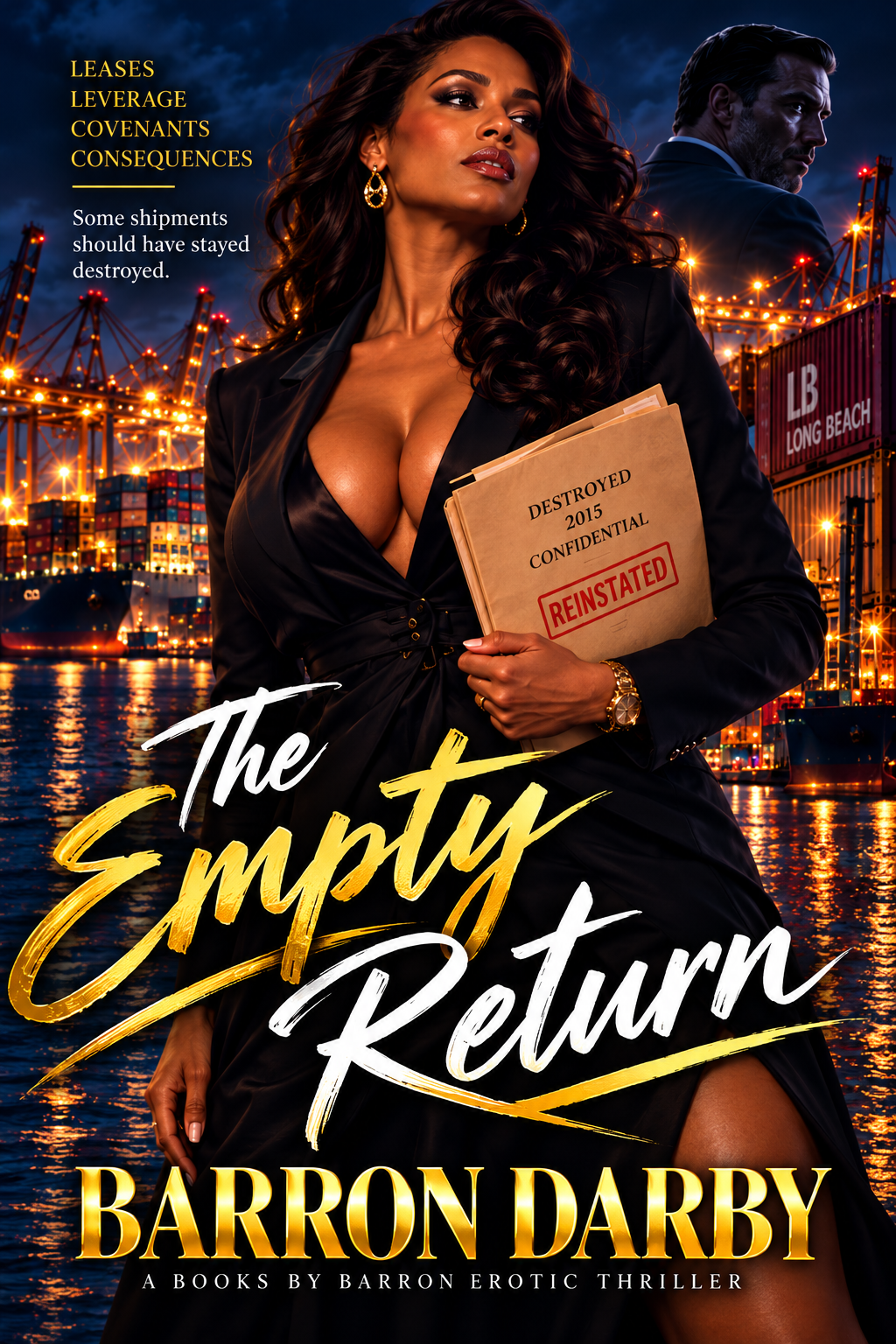
The Empty Return
Some shipments should have stayed destroyed.
Written by Barron Darby
Ebook · Kindle · Hardcover ISBN 979-8-953029-95-7 · Books By Barron
Malika Thorne runs fourteen thousand shipping containers out of the last independent depot in the Long Beach harbor district, and she is one bad quarter from a covenant she promised her bank she would never approach. Then a Korean carrier offers her the master lease her father was refused in 2011, and sends a man to look at her books.
Anselm Rooker has a checklist, a rental car and a plane to catch. He wants serial level fleet data no buyer would need. He wants her, and he says so on the first night, and she lets him in anyway, because she is forty one years old and tired of being the most careful person in every room she walks into.
What he actually wants is her signature. Four hundred and six boxes certified destroyed nine years ago are being brought home under her prefix, and the paperwork she signs turns dead steel back into live assets. By the time she reads the disposal file under the stack lights at midnight, she has already given him the gate codes, the serial list and everything else.
Her yard manager confesses. It is true and it is not enough. Her father refused the same signature and lost everything for it. And on the last Friday in October, in a conference room twelve floors above Ocean Boulevard, Malika finds out what is actually riding inside those boxes and whose name is on the manifest as exporter of record.
Leases. Leverage. Covenants. Consequences. A Books By Barron erotic thriller.
Chapter One
▶ TAP TO PLAY CHAPTER ONEChapter one is read by Jessica Anne Bogart. To hear the rest, buy the eBook, open the EPUB in the free ElevenReader app, and pick a voice. The whole story, read to you.
A man in a bad suit had my skirt up around my waist and both hands full of my ass before my office door had finished closing, on Monday the twentieth of October, with a master lease on my desk and fourteen thousand boxes on my back, and I had my heel hooked behind his knee so he could not have backed off me if he had wanted to leave, and the thing about me that I have never said out loud in a lit room is that I have carried everything by myself since I was twenty two years old, and what I want, the only thing I have ever really wanted from a man, is to put it down for one hour and have somebody else hold it. That is what the sex is. Not the men. The hour. Finding that out cost me my father’s company.
“Say the words.”
“Which words.”
“The ones you came up here carrying. I am not doing this with a man who is going to call it a conversation tomorrow.”
He laughed into my neck. Anselm Rooker had a laugh like something coming loose in a wall.
“I came up here to fuck you on that desk.”
“Then do the work.”
“You want the watch off first?”
“The watch stays.”
That is how the whole thing started. Me saying no to a question nobody had asked me in six years, and a man doing what I told him, and both of us knowing that the telling was the part I needed and the doing was the part I wanted.
He put me on the edge of my father’s desk, the one I have sat behind since I was thirty four. The blotter and the stapler and fourteen thousand boxes’ worth of paper went under me. He did not hurry. He stood between my knees and studied me for a long moment like a man reading a page he intended to remember, and then he got my blouse open one button at a time with his mouth on my neck, and then my bra pushed up. His hands came up under my titties and held them, thumbs moving over my nipples, and did nothing else for what felt like a minute. My nipples have never in my life needed encouragement and they did not need any that night. I made a sound in a building with nobody in it. He smelled of hotel soap and the rental car and a long day, and I put my face in his collar and breathed him in like a woman who had not been near a man in four years, because that is what I was.
“Hold still.”
“Make me.”
So he made me. He got one hand spread flat on my sternum and pushed me back onto my own paperwork, and he held me there. My whole body went quiet and loud at once. I have never been still in my life. Nobody has ever made me. The other hand went up between my thighs and found me already soaked through, and the sound he made about it went straight down the middle of me.
“Malika.”
“Do not start.”
“I have not said anything.”
“You said my name like a man finding money.”
“I found something.”
The Yard Dog woke up in me right about then. That is what I call her, the part of me that has been running a container yard since she was twenty seven and takes nothing off anybody. I will explain her properly in a minute, because people are smart and it is the first thing they will ask. She wanted his mouth. I told him so out loud, in words I would not use in front of my mother.
He went down on his knees between my legs on the carpet my father picked out in 1986. He put his tongue on my clit, and stayed there. Not searching. Staying.
Terrance Lassiter was my husband for six years and that man treated my pussy like a phone number he almost remembered. This one parked.
I had a handful of his hair and my other hand spread on the desk. Ninety seconds in he put two fingers in me and turned them up, and then he bit the inside of my thigh hard enough to leave a mark, and I came so fast that I laughed out loud, and the laughing was the thing. Nobody had ever made me laugh in a bed, and it was not a bed, and I did not care.
“That was quick.”
“Get up here.”
“I am not finished down here.”
“You are finished when I say so.”
He was not finished. He stood up with his mouth shining and undid his belt one handed, and I got his dick out and it was heavy and hot in my hand, and I worked it slow the way I like, just to watch a grown man lose the thread of a sentence. I was happy. I am putting that word in early because everybody will expect the other one.
“Turn around.”
“Ask me nice.”
“Turn around, Malika.”
I turned around. I put my palms flat on my father’s desk and looked out at the cranes lit up yellow across the channel, and he went into me in one long push with his hand spread across the low of my back. I said his whole name at a window. What I was thinking about, while it happened, was the letter. A carrier in Seoul had written to me that morning offering me the contract my father was refused in 2011, and a man had come to look at my books before anybody negotiated anything, and the man was inside me with his hand on my spine, and I thought, quite clearly, this is the best day of my working life and I am going to have to pay for it. The second one came up through me slow and lasted long enough that I lost the room.
He finished with his forehead between my shoulder blades, both of us breathing like we had run up the stairs.
Then he pulled his pants up, picked my skirt off the floor, handed it over and said, “I have a seven forty out of Long Beach.”
And he left.
I stood in the centre of my own office with my father’s gold watch still on my wrist and my blouse hanging open and my legs not entirely working. I laughed again, because it had been a very long time, and because for one hour somebody else had been holding it.
That man was not buying my company.
That man was not an acquisitions principal. Kestrel Ridge Partners was not a fund. There was no seven forty out of Long Beach.
Six days after that night I signed one sheet of paper. Not the big one. A gate approval, sixty two units, about something that had already happened, on a Sunday morning, with my father’s pen.
Eleven days after that night I was sitting twelve floors above Ocean Boulevard with a second document in front of me and a pen laid across it, and that one would have brought four hundred dead shipping containers back to life and put my company’s name on a manifest as exporter of record for cargo the Treasury Department of the United States will not let an American touch.
The whole eleven days was built to get my hand on that second pen.
It cost me the contract, the fleet, four people off my payroll and my father’s watch off my wrist.
And every bit of it was my own doing. Nobody held a pen in my hand, and nobody had to, and the entire trick is that they only ever needed the small one first, and they only ever needed to find the one hour a week when I wanted somebody else to hold it.
I want that said at the front so nobody gets confused about what kind of story this is going to be.
And I want the why said at the front too, because the first question anybody asks about a woman on a desk is why is she like that, and who made her. Nobody made me. My father put me on a gate at twenty three for a summer to teach me a lesson, and the lesson was that nobody is coming. He did the whole company on his own from the first box to the last signature and he told nobody, and he raised a daughter who does it the same way. The Yard Dog is my name for her. She is the reason I have been divorced for six years and not lonely for one hour of it, and she is the reason a decent man spent six years of marriage asking me whether I was sure, and never once just knew. Being asked if you are sure by a man who loves you is the loneliest thing that has ever been done to me. I do not want to be asked. I want to be told, once, and have him remember. I want to be held still, because I have never in my life been still. I have never said that to a living soul, because in this harbor a want is inventory and I would rather be the woman holding the list. The part of me that wants to be run I never gave a name, because I did not want to find out she and the Yard Dog are the same woman. On my father’s desk that night, with a stranger’s hand holding me flat, I found out.
—
Monday, the twentieth of October, which in this business is the last week of the world.
Peak season. Every empty box in the Pacific is worth arguing about in October, and by the second week of November they are worth what a beer can is worth, and that swing is the entire business. My father used to say a container lessor makes all his money in nine weeks and spends the other forty three explaining himself.
I got in at five fifty. I always arrive at five fifty. Thorne Intermodal Leasing has an office on the second floor of a building on Pico that my father bought in 1991 when nobody wanted a building on Pico. We have a depot on Terminal Island that is the last privately held acre inside the harbor district, and it is the only reason anybody in this town returns my calls.
Fourteen thousand boxes on lease. Twelve people on payroll. One of me.
Lourdes Prieto was already at her desk with her braids up off her neck and two phones going, which is how she has been every October for twelve years.
“Two things, and you will like one of them.”
“Give me the good one.”
“Hanshin Star.”
I put my bag down slowly. “Say the rest.”
“Hanshin Star Line. Their commercial office in Seoul. A letter came in at four this morning our time and it is not a rate sheet, Malika, it is an invitation to negotiate a master lease. Five years. Everything we have and everything we can buy.”
“Read it to me.”
“I have already read it to you eleven times inside my own head.”
“Read it anyway.”
She read it. I stood in the middle of the floor in my coat with my keys still in my fist and listened to a woman from Wilmington read a letter from Seoul offering me the exact contract my father was refused in 2011. I did not sit down. I have a rule about not sitting down when something good happens. The chair makes it real and then it can be taken.
“Fine.”
“Fine? That is your whole answer?”
“What is the second thing.”
“The second thing comes attached to the first. They are sending somebody through the books before anybody negotiates anything.”
“Somebody from where.”
“A fund. Kestrel Ridge Partners, out of Dallas. Hanshin uses them for transaction support.” She held up a hand before I could open my mouth. “I know. I asked. It is normal, it is boring, every carrier alive does it, and if you fight it you look like a woman with something in a drawer.”
“I have something in a drawer.”
“I know exactly what is in the drawer. I put it in there.”
That is Lou. Twelve years, and she has never once made me say a thing out loud that she could say for me.
What was in the drawer was this covenant. My facility with Harbor Pacific Bank is written against a fleet count. Not revenue, not coverage, a count, because the man who drafted it in 2014 was a simple man and I have been grateful for him every day since that summer. If Thorne Intermodal drops below the covenant number of boxes on the register, the facility reprices, and my depot becomes collateral somebody else gets to hold.
Since March I had been buying my father’s own retired boxes back off the secondary market at a loss. Twenty here, thirty there. Beat up forty foot dry vans from the nineties that no carrier wants, bought at a price that makes no commercial sense whatsoever, for one reason. A rusted box on the register counts exactly the same as a new box.
I was eleven boxes over the number that Monday morning. Eleven.
“He lands at two,” Lou said. “He asked for the conference room and the fleet register.”
“He gets the conference room.”
“Malika.”
“He gets the conference room, Lou.”
—
He did not use the conference room.
Anselm Rooker came through my door at four ten in the afternoon in a dark suit that fit him nowhere. No bag. No laptop. A phone he did not look at once. He sat down in the chair across from my desk before I offered him the chair.
Six three. Grey coming in at the temples. A jaw that had been broken at some point in his life and set by somebody in a hurry, which was the first thing about him I liked, and I will not pretend otherwise this late.
“Anselm Rooker. Kestrel Ridge. You are Malika Thorne.”
“That is me.”
“Your father built this company.”
“He built all of it.”
“And you have run it since he died, and your fleet count went up in a year when everybody else lost boxes, which is either very good management or something else.”
I have been in rooms with men who came in swinging. That was not swinging. He said it the way a person says the sky is doing something.
“It is good management.”
“It might be.”
“You have been in my office four minutes.”
“I have been inside your filings a great deal longer than four minutes.” He sat back. “Miss Thorne, I am going to be direct, because I have read enough about this company to know you do not enjoy the other thing. I do not care about your income statement. Hanshin does not care about your income statement either. What I need is your fleet register at serial level, every unit, with disposal history, going back nine years.”
“Nine years.”
“Every unit, every code.”
“Nobody buying a company asks for nine years of serials.”
“Nobody buying a company would ask. I am asking.”
We sat in that. Out the window the cranes at Pier G came on one bank at a time, the way they do at dusk, and the room went the colour it goes in October at five o’clock.
“Why.”
“Because a fleet register is the only document in this business nobody bothers to lie inside,” he said. “Everything else is a story somebody tells a bank. Your register is steel with numbers on it, sitting somewhere, or not sitting anywhere.”
“And if I refuse.”
“Then you refuse, and I write a memo, and Hanshin offers the master lease to the second name on their list. You stay eleven boxes over your covenant until February. Then the market turns and you are not over anything.”
He knew the number. He said the number flat, with no pleasure in it whatsoever, which was worse than pleasure.
I should have put him out of my building right then. I knew it while it was happening. Do I get credit for knowing? There was one clean second where I could see myself standing up and saying we are done here, and I did not take that second. The reason was not the contract and was not my father and was not the bank.
He had not looked at my chest once. He had not called me impressive. He had not said one word about a woman running a depot. By forty one a woman gets so tired of being handled that a man who simply wants a thing from her starts to feel like fresh air, and I have said what I want, so anybody reading this already knows what a man like that is to a woman like me. He is the one hour.
“You will have it in the morning.”
“I will have it tonight.”
“I said morning.”
“Your server is in this building, your operations manager went home at six, and you have been sitting in that chair eleven hours.” He stood up. “I am not in a hurry, Miss Thorne. I do not believe you are in one either.”
Then he waited.
Not the way a man waits when he is about to leave. The other way. The way a man waits when he has asked a question he never said out loud, and is perfectly willing to stand in a doorway as long as it takes.
Nobody had ever waited for me. Men arrive at a woman like a truck arrives at a gate. This one stood in my doorway with his hands at his sides and let me decide, and something came up out of my chest that was not gratitude. It was closer to rage. Where had this been my whole life.
I got up. I shut the office door. I put my back against the wood.
“Say the words.”
I have already put down what he said, and what he did after, and that my father’s watch stayed on my wrist the whole time.
What I have not put down is that at eleven twenty that night, in my apartment in Belmont Shore, with my hair wet and my legs still tender and the mark of his teeth going purple on the inside of my thigh, I sat at my own kitchen counter and exported nine years of serial history to a man I had known seven hours.
Four hundred and six of those units carried a disposal code.
I did not open them. Not that night. I sat there with the file sent and my hand flat on the counter, and what I was thinking about was not the code. It was his palm on my chest, holding me down on my own paperwork, and how quiet I had gone under it, and how badly I wanted to go quiet like that again.
I have thought about that failure more than I have thought about anything else in my life.
Read the rest, or open the EPUB in ElevenReader and keep listening.
Paperback ISBN 979-8-953029-95-7 · Books By Barron