
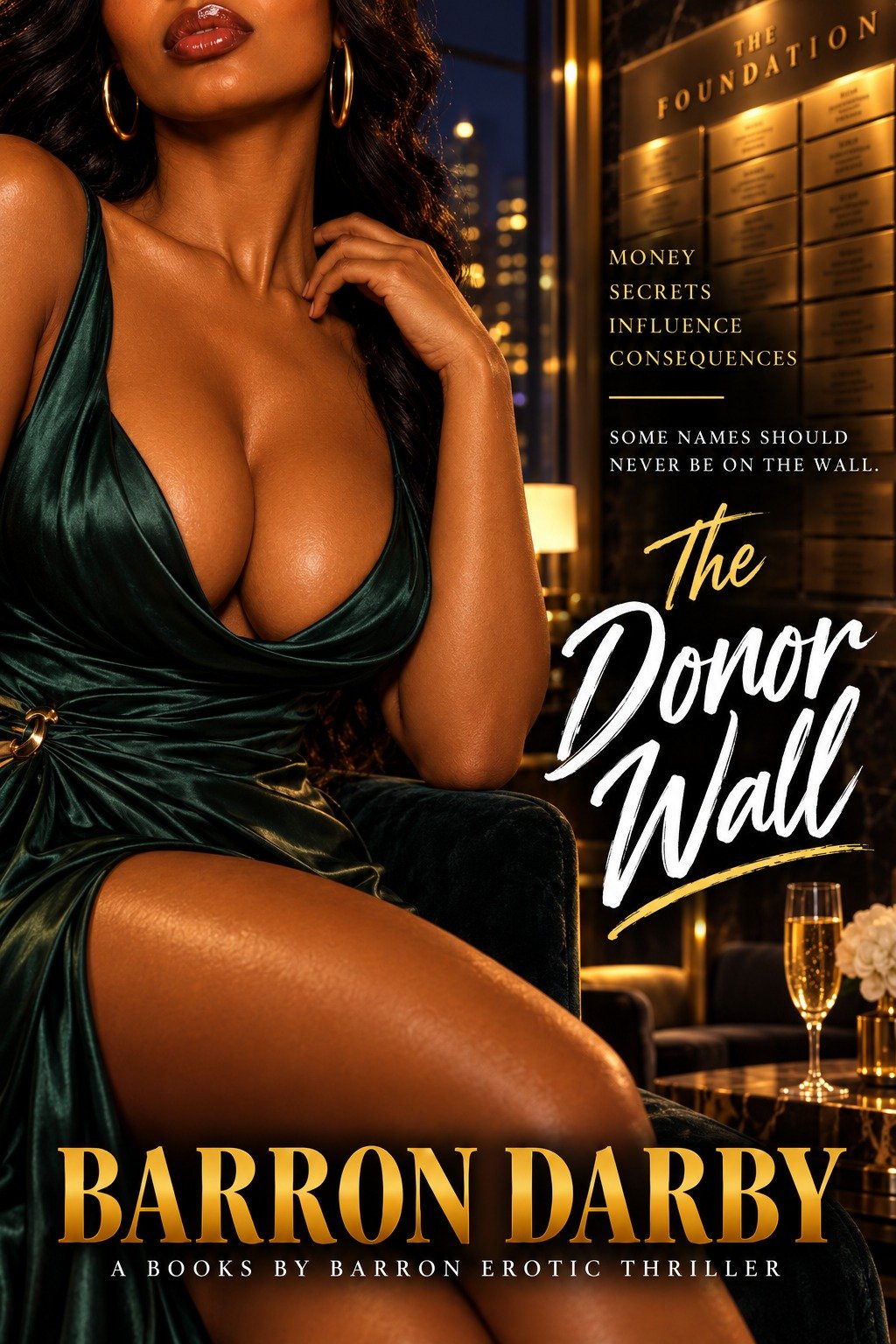
The Donor Wall


Payment Secure checkout by Stripe
Pay with Card, Google Pay, Cash App or Link
Format PDF + EPUB, no DRM
Explicit · adults only
About this book
He Gave Eleven Years to Carve One Name in Stone
Rochelle Danner has forty feet of black granite going up in the atrium of a building that does not have a roof yet, and six recognition tiers cut into it, and a blank at the top where the largest anonymous gift in the hospital’s history is supposed to become a name.
She has receipted that donor for nine years. Twenty five million dollars, wired every year or two, always on the first business day of a month, always without a word. She has never met the man’s lawyer in person. She has never seen a signed agreement. She has signed four audit letters saying otherwise.
Two floors down, a gift accountant nobody wanted back is reconciling eleven years of bank wires against eleven years of receipts, because that is the job and because in 2019 she wrote a memo about this donor and was moved to another department eleven days later.
The donor of record is an estate that was discharged by the Jefferson County Probate Court in July 2014. It has given nine times since it stopped existing.
The money is real. The money is clean. And the amounts are not round.
Chapter One
The proof came in on a hand truck under quilted moving blankets, strapped with a ratchet, and Amos Renfro would not let anybody else touch the straps.
“Two hundred and ten pounds,” he said. “In a photograph it looks like forty feet of wall. In this room it is one panel, and it is heavier than your table.”
Rochelle Danner moved the table anyway. She took one end and Talia took the other. The casters shrieked on carpet tile for three feet. The sound went out the open door and down the hall, where twenty-two people were pretending to work.
Renfro undid the ratchet. He peeled the blankets back one at a time, folding each one before he started the next. Under the last of them the granite came up out of the wool like water in a dark bucket.
It was black. Not charcoal. Not near-black. Black the way a well is black, with a polish that took the ceiling lights and gave them back doubled and cold.
Along the top, cut an eighth of an inch deep and filled with leaf, four words caught the light and let go of it when she shifted her weight.
THE FOUNDERS WALL.
Below that, six bands. Six tiers, each ruled off from the next by a hairline groove. In every band stood a column of names in a Roman face with serifs like the ends of chisels. Silver leaf for the lower four. Gold for the top two, larger, and there were very few of them.
Rochelle put her reading glasses on her nose. Actually on her nose, which happened perhaps twice a month.
The bottom band was crowded. Two hundred and six names. Some of them she had earned herself over nine years. Some had been on the hospital’s paper since before her mother was born. She read down the column past the Hollowells, past the Kyzars, past Mount Hebron Missionary Baptist, and near the foot of it a line of type said ANONYMOUS, FOURTEEN GIFTS.
A list like that always did the same thing to Rochelle. A city is a real object, and this was a photograph of one.
Then she looked at the top.
The top band carried a header cut into the left margin. FOUNDERS CIRCLE. Under it, two names in gold, each the height of her thumb.
THE ASHCRAFT FAMILY. LILLIAN AND M. T. KYZAR.
Under those a third line, the same size, the same leaf, the same chisel serifs.
XXXXXXXXXXXXXXXXXXXX.
Twenty X’s. A placeholder, cut properly, polished properly, filled with real gold. Renfro did not do things by halves. He had told her so on the telephone in March.
“That is twenty characters, spaces included,” Renfro said. “That is what the band takes at that cap height before I drop to the next size. Drop to the next size and the top tier is smaller than the second tier. Then the whole wall looks like a mistake.”
“Twenty.”
“Twenty. Give me twenty-one and I cut a second line. A second line in the Founders Circle looks like a family with something to prove.” He laid a hand flat on the honed edge, away from the polish. “Mrs. Danner, I have been doing this forty-one years. You want the top line short. Short is money. Long is a man who paid for the wall.”
Talia Oyelaran had her tablet up, photographing the top band close, from three angles. “What is your lead time on the cut once you have the name?”
“Nine working days on the letter. Two more for the leaf to cure on a small panel, four on a band that size. Then I need eleven days in the building to set the panels. I do not set stone in a room with drywall dust in the air.”
“The atrium closes to trades November second.”
“Then the name has to be in my hand by the twenty-sixth of October. I would rather have it the nineteenth.” Renfro straightened. A jeweler’s loupe hung on a lanyard against his chest. He had a carpenter’s shoulders and forearms mapped with old white scars. “One customer in my life gave me a name late. A church in Talladega. I cut it on site with a pneumatic. You can see the difference from the door.”
Rochelle heard the date. Her hand went up into her hair for the glasses, found them already on her face, came down again.
“The nineteenth,” she said.
“Nineteenth is better.”
“You will have it by the nineteenth.”
She heard the promise leave her mouth. The floor of her stomach went out from under the words, the way it does when a mouth has gone on ahead of its owner. Her face did not move. She had learned the trick in a room in 2019, and nothing since had tested it this hard.
Renfro wrapped the panel again. He worked in reverse order, blanket by blanket, taking his time. Nobody rushed him. With the ratchet tight he shook Talia’s hand, then Rochelle’s, and said the thing stonecutters must say to every client. In a hundred years every person in this building would be gone. The wall would be the only thing still saying any of it out loud.
Then he took his hand truck down the freight elevator with his two hundred and ten pounds of granite.
Rochelle stood in her own conference room. The table sat three feet out of true. Four bright rectangles showed in the carpet where the legs had lived.
Talia was already writing.
“I will put the nineteenth on the master,” she said. “Amber or red?”
“Amber.”
“It is a five-week run.”
“Amber.”
Talia looked up. She had a way of stopping mid-motion that was not hesitation. It was arithmetic. Rochelle had hired her for it and was now on the receiving end of it twice a week.
“Rochelle. Is there a reason it is not red?”
“There is a reason it is amber.”
“That is an echo, not an answer.”
“No,” Rochelle said. “Not the same answer at all.”
She went down the hall to her own office and shut the door. She never shut the door. The latch clicked. Four people had watched her hand go to the knob.
Her office faced east across Twentieth Street at the hospital. Eleven floors of 1957 brick with a glass tower bolted to the flank in 2004. Behind both of them, rising out of a hole that had been surface parking for thirty years, nine floors of steel with concrete on five and a tower crane over the top.
The Bray Heart and Vascular Institute. Two hundred and fourteen million dollars, of which she had raised a hundred and ninety-six.
She sat down without taking her jacket off and woke the screen.
The foundation kept its records in a system called Tessellate, sold to the hospital in 2011 by a company that no longer existed. Rochelle had twice failed to get it replaced. She typed the string she had typed perhaps forty times in nine years, and had never once typed with this feeling in her hands.
4417
The record filled the screen in the flat grey of software written for a monitor shape nobody manufactures any more.
CONSTITUENT 4417. SORT NAME: ANONYMOUS – DONOR 4417. RECOGNITION: Anonymous. Do not publish. Do not acknowledge in print. SOLICITOR: DANNER, R. (2017- ). PRIOR SOLICITOR: WHITTAKER, J. (2015-2017). CONTACT: GUTHRIDGE, LOWELL S., ESQ. – representative Nashville TN – telephone only – DO NOT MAIL LIFETIME GIVING: $25,778,430.00. GIFTS: 9. LAST GIFT: 09/01/2025 $3,502,780.00. PLEDGE: none of record AGREEMENT: none of record
She read the last two lines. She had read them before. She had read them in 2017, when Jim Whittaker retired and handed her a spreadsheet and a shrug. She had read them in 2019. She had read them in 2021. She had read them in January, when the audit letter came around for her signature the fourth time.
None of record. None of record.
Twenty-five million, seven hundred and seventy-eight thousand, four hundred and thirty dollars.
Sitting became impossible. She got up and stood at the window with her hands on the sill and looked at the crane.
The granite in her conference room had laid the whole shape out for her in forty minutes, and she had never once let herself lay it out in a single line.
A donor had given her foundation twenty-five and three-quarter million dollars over eleven years. That donor had a lawyer with a Nashville area code who returned calls inside a day and had never once been rude. There was no pledge agreement. No gift agreement. No letter of intent, no term sheet, no signature on anything, no restriction on any of it, no name. In nine years she had never sat in a room with one human being connected to the money.
She had told herself a story. The story was true. Some people do not want to be known, the wanting is sincere, and a foundation that cannot receive a gift from a person who wishes to remain unknown has decided its own comfort matters more than a cardiac floor. She had said a version of it out loud to a board committee in 2018. They had applauded.
Every year the money came. The money was clean. The money built the seventh floor. It built the catheterization suites, the endowed chair in vascular surgery, two hundred and sixty scholarships. The not-knowing had gone from a courtesy to a habit, from a habit to a policy, from a policy to a fact of the building. Now a man from Wetumpka wanted twenty characters by the nineteenth of October.
Because a wall is not a receipt.
Recognition at the top tier was not a favor the foundation did for a donor. It was a representation the foundation made to a city. Cut a name in gold into the Founders Circle and the hospital said, in the most permanent material money can buy, that this person gave us twenty-five million dollars and here is their name. Auditors tested the claim. They tested the claim by asking to see the agreement.
She had signed four representation letters. Each one said the foundation’s recognition of major gifts rested on executed documentation.
Rochelle Danner put her forehead against the cool of the window glass for three seconds. Then she stood up straight. Her office had a second window onto the corridor and she had not dropped the blind.
She went back to the desk and did the thing she did well. She stopped feeling something and started making a list.
Legal pad. Pencil.
1. Guthridge. Call. Ask for the agreement. Do not ask for a name. 2. Treasury. Eleven years of incoming wire advices. Raw. From the bank, not out of Tessellate. 3. Sprague. What does the hospital need to see before we cut stone. 4. Whittaker. What was he told in 2015.
She looked at the four lines. Then she wrote a fifth.
5. Who receipted these nine gifts.
She sat with the pencil against her lower lip. She did not know the answer to number five. She had never known the answer. A gift of three and a half million dollars arriving on a Monday in September gets entered into a database by some person at some desk, and she could not have named the desk.
She picked up the phone and called the foundation’s controller.
“Gaylene. Who does gift entry on wires over a million.”
“Well, good morning to you as well.” Gaylene Thrash laughed, the way she laughed at everything, a small dry sound like a page turning. “Wires come in on the bank report. Treasury posts them to the depository account. Gift accounting matches and receipts. Why?”
“Who is gift accounting.”
“Right this minute? Right this minute it is the contract lady. Ruth Ann.”
Rochelle wrote the name on the pad. “Ruth Ann who.”
The pause on the line lasted half a second. Rochelle had spent nine years listening to people on telephones. She heard it the way Renfro would hear a flaw in a slab.
“Sedberry,” Gaylene said. “Ruth Ann Sedberry. She is on the nine-month for the audit reconciliation, in the back by the copy room.”
“How long has she been in the building.”
“Since January.”
“And before January.”
“Before January she was down in Patient Financial Services.” Gaylene’s voice had gone smooth, the way a voice goes smooth. “For some years. Rochelle, is there something I ought to know?”
Through the open doorway Rochelle could see the four bright rectangles in the carpet, and past them the wall of the conference room, which was drywall, painted, holding up nothing at all.
“I will come to you this afternoon,” she said.
She hung up and underlined the name twice. Then she wrote beside it, in smaller letters, pressing hard enough to dent the sheet underneath.
Why was she in Patient Financial Services.
Did chapter one make you want chapter two?
This comes straight to me. No account, no purchase, nothing posted publicly.
The proof came in on a hand truck under quilted moving blankets, strapped with a ratchet, and Amos Renfro would not let anybody else touch the straps.
“Two hundred and ten pounds,” he said. “In a photograph it looks like forty feet of wall. In this room it is one panel, and it is heavier than your table.”
Rochelle Danner moved the table anyway. She took one end and Talia took the other. The casters shrieked on carpet tile for three feet. The sound went out the open door and down the hall, where twenty-two people were pretending to work.
Renfro undid the ratchet. He peeled the blankets back one at a time, folding each one before he started the next. Under the last of them the granite came up out of the wool like water in a dark bucket.
It was black. Not charcoal. Not near-black. Black the way a well is black, with a polish that took the ceiling lights and gave them back doubled and cold.
Along the top, cut an eighth of an inch deep and filled with leaf, four words caught the light and let go of it when she shifted her weight.
THE FOUNDERS WALL.
Below that, six bands. Six tiers, each ruled off from the next by a hairline groove. In every band stood a column of names in a Roman face with serifs like the ends of chisels. Silver leaf for the lower four. Gold for the top two, larger, and there were very few of them.
Rochelle put her reading glasses on her nose. Actually on her nose, which happened perhaps twice a month.
The bottom band was crowded. Two hundred and six names. Some of them she had earned herself over nine years. Some had been on the hospital’s paper since before her mother was born. She read down the column past the Hollowells, past the Kyzars, past Mount Hebron Missionary Baptist, and near the foot of it a line of type said ANONYMOUS, FOURTEEN GIFTS.
A list like that always did the same thing to Rochelle. A city is a real object, and this was a photograph of one.
Then she looked at the top.
The top band carried a header cut into the left margin. FOUNDERS CIRCLE. Under it, two names in gold, each the height of her thumb.
THE ASHCRAFT FAMILY. LILLIAN AND M. T. KYZAR.
Under those a third line, the same size, the same leaf, the same chisel serifs.
XXXXXXXXXXXXXXXXXXXX.
Twenty X’s. A placeholder, cut properly, polished properly, filled with real gold. Renfro did not do things by halves. He had told her so on the telephone in March.
“That is twenty characters, spaces included,” Renfro said. “That is what the band takes at that cap height before I drop to the next size. Drop to the next size and the top tier is smaller than the second tier. Then the whole wall looks like a mistake.”
“Twenty.”
“Twenty. Give me twenty-one and I cut a second line. A second line in the Founders Circle looks like a family with something to prove.” He laid a hand flat on the honed edge, away from the polish. “Mrs. Danner, I have been doing this forty-one years. You want the top line short. Short is money. Long is a man who paid for the wall.”
Talia Oyelaran had her tablet up, photographing the top band close, from three angles. “What is your lead time on the cut once you have the name?”
“Nine working days on the letter. Two more for the leaf to cure on a small panel, four on a band that size. Then I need eleven days in the building to set the panels. I do not set stone in a room with drywall dust in the air.”
“The atrium closes to trades November second.”
“Then the name has to be in my hand by the twenty-sixth of October. I would rather have it the nineteenth.” Renfro straightened. A jeweler’s loupe hung on a lanyard against his chest. He had a carpenter’s shoulders and forearms mapped with old white scars. “One customer in my life gave me a name late. A church in Talladega. I cut it on site with a pneumatic. You can see the difference from the door.”
Rochelle heard the date. Her hand went up into her hair for the glasses, found them already on her face, came down again.
“The nineteenth,” she said.
“Nineteenth is better.”
“You will have it by the nineteenth.”
She heard the promise leave her mouth. The floor of her stomach went out from under the words, the way it does when a mouth has gone on ahead of its owner. Her face did not move. She had learned the trick in a room in 2019, and nothing since had tested it this hard.
Renfro wrapped the panel again. He worked in reverse order, blanket by blanket, taking his time. Nobody rushed him. With the ratchet tight he shook Talia’s hand, then Rochelle’s, and said the thing stonecutters must say to every client. In a hundred years every person in this building would be gone. The wall would be the only thing still saying any of it out loud.
Then he took his hand truck down the freight elevator with his two hundred and ten pounds of granite.
Rochelle stood in her own conference room. The table sat three feet out of true. Four bright rectangles showed in the carpet where the legs had lived.
Talia was already writing.
“I will put the nineteenth on the master,” she said. “Amber or red?”
“Amber.”
“It is a five-week run.”
“Amber.”
Talia looked up. She had a way of stopping mid-motion that was not hesitation. It was arithmetic. Rochelle had hired her for it and was now on the receiving end of it twice a week.
“Rochelle. Is there a reason it is not red?”
“There is a reason it is amber.”
“That is an echo, not an answer.”
“No,” Rochelle said. “Not the same answer at all.”
She went down the hall to her own office and shut the door. She never shut the door. The latch clicked. Four people had watched her hand go to the knob.
Her office faced east across Twentieth Street at the hospital. Eleven floors of 1957 brick with a glass tower bolted to the flank in 2004. Behind both of them, rising out of a hole that had been surface parking for thirty years, nine floors of steel with concrete on five and a tower crane over the top.
The Bray Heart and Vascular Institute. Two hundred and fourteen million dollars, of which she had raised a hundred and ninety-six.
She sat down without taking her jacket off and woke the screen.
The foundation kept its records in a system called Tessellate, sold to the hospital in 2011 by a company that no longer existed. Rochelle had twice failed to get it replaced. She typed the string she had typed perhaps forty times in nine years, and had never once typed with this feeling in her hands.
4417
The record filled the screen in the flat grey of software written for a monitor shape nobody manufactures any more.
CONSTITUENT 4417. SORT NAME: ANONYMOUS - DONOR 4417. RECOGNITION: Anonymous. Do not publish. Do not acknowledge in print. SOLICITOR: DANNER, R. (2017- ). PRIOR SOLICITOR: WHITTAKER, J. (2015-2017). CONTACT: GUTHRIDGE, LOWELL S., ESQ. - representative Nashville TN - telephone only - DO NOT MAIL LIFETIME GIVING: $25,778,430.00. GIFTS: 9. LAST GIFT: 09/01/2025 $3,502,780.00. PLEDGE: none of record AGREEMENT: none of record
She read the last two lines. She had read them before. She had read them in 2017, when Jim Whittaker retired and handed her a spreadsheet and a shrug. She had read them in 2019. She had read them in 2021. She had read them in January, when the audit letter came around for her signature the fourth time.
None of record. None of record.
Twenty-five million, seven hundred and seventy-eight thousand, four hundred and thirty dollars.
Sitting became impossible. She got up and stood at the window with her hands on the sill and looked at the crane.
The granite in her conference room had laid the whole shape out for her in forty minutes, and she had never once let herself lay it out in a single line.
A donor had given her foundation twenty-five and three-quarter million dollars over eleven years. That donor had a lawyer with a Nashville area code who returned calls inside a day and had never once been rude. There was no pledge agreement. No gift agreement. No letter of intent, no term sheet, no signature on anything, no restriction on any of it, no name. In nine years she had never sat in a room with one human being connected to the money.
She had told herself a story. The story was true. Some people do not want to be known, the wanting is sincere, and a foundation that cannot receive a gift from a person who wishes to remain unknown has decided its own comfort matters more than a cardiac floor. She had said a version of it out loud to a board committee in 2018. They had applauded.
Every year the money came. The money was clean. The money built the seventh floor. It built the catheterization suites, the endowed chair in vascular surgery, two hundred and sixty scholarships. The not-knowing had gone from a courtesy to a habit, from a habit to a policy, from a policy to a fact of the building. Now a man from Wetumpka wanted twenty characters by the nineteenth of October.
Because a wall is not a receipt.
Recognition at the top tier was not a favor the foundation did for a donor. It was a representation the foundation made to a city. Cut a name in gold into the Founders Circle and the hospital said, in the most permanent material money can buy, that this person gave us twenty-five million dollars and here is their name. Auditors tested the claim. They tested the claim by asking to see the agreement.
She had signed four representation letters. Each one said the foundation’s recognition of major gifts rested on executed documentation.
Rochelle Danner put her forehead against the cool of the window glass for three seconds. Then she stood up straight. Her office had a second window onto the corridor and she had not dropped the blind.
She went back to the desk and did the thing she did well. She stopped feeling something and started making a list.
Legal pad. Pencil.
1. Guthridge. Call. Ask for the agreement. Do not ask for a name. 2. Treasury. Eleven years of incoming wire advices. Raw. From the bank, not out of Tessellate. 3. Sprague. What does the hospital need to see before we cut stone. 4. Whittaker. What was he told in 2015.
She looked at the four lines. Then she wrote a fifth.
5. Who receipted these nine gifts.
She sat with the pencil against her lower lip. She did not know the answer to number five. She had never known the answer. A gift of three and a half million dollars arriving on a Monday in September gets entered into a database by some person at some desk, and she could not have named the desk.
She picked up the phone and called the foundation’s controller.
“Gaylene. Who does gift entry on wires over a million.”
“Well, good morning to you as well.” Gaylene Thrash laughed, the way she laughed at everything, a small dry sound like a page turning. “Wires come in on the bank report. Treasury posts them to the depository account. Gift accounting matches and receipts. Why?”
“Who is gift accounting.”
“Right this minute? Right this minute it is the contract lady. Ruth Ann.”
Rochelle wrote the name on the pad. “Ruth Ann who.”
The pause on the line lasted half a second. Rochelle had spent nine years listening to people on telephones. She heard it the way Renfro would hear a flaw in a slab.
“Sedberry,” Gaylene said. “Ruth Ann Sedberry. She is on the nine-month for the audit reconciliation, in the back by the copy room.”
“How long has she been in the building.”
“Since January.”
“And before January.”
“Before January she was down in Patient Financial Services.” Gaylene’s voice had gone smooth, the way a voice goes smooth. “For some years. Rochelle, is there something I ought to know?”
Through the open doorway Rochelle could see the four bright rectangles in the carpet, and past them the wall of the conference room, which was drywall, painted, holding up nothing at all.
“I will come to you this afternoon,” she said.
She hung up and underlined the name twice. Then she wrote beside it, in smaller letters, pressing hard enough to dent the sheet underneath.
Why was she in Patient Financial Services.
Follow the reading and listening instructions beside the cover to continue with the whole book.
Paperback ISBN 979-8-953029-11-7 · Books By Barron