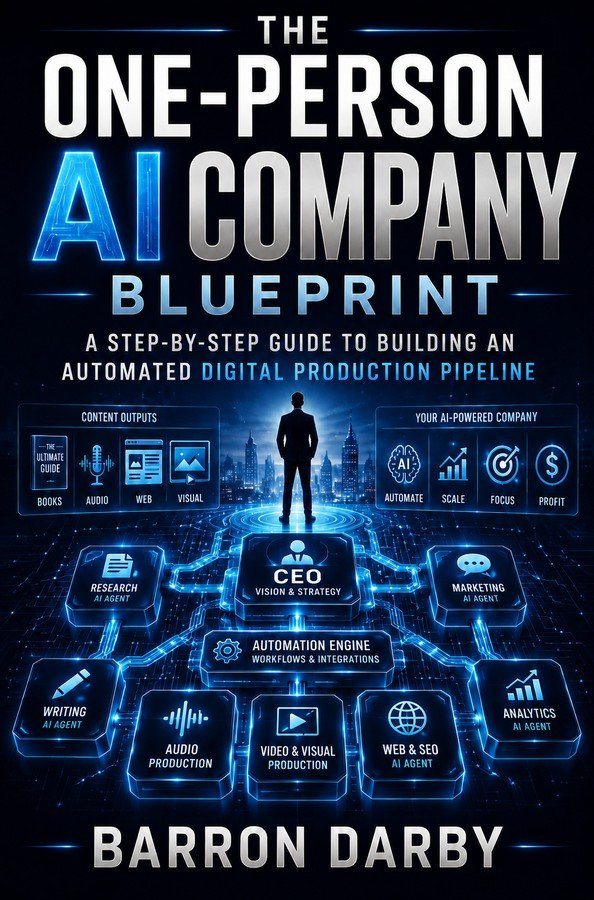
Chapter one is read by Jessica Anne Bogart. To keep reading, buy the Kindle edition on Amazon.
Somewhere around the fourth month I stopped counting hours and started counting handoffs.
The book was finished. That was the easy part, and I want to be honest that it was the easy part, because every writer I know believes the writing is the mountain and everything after it is a gentle walk down. It is not. The manuscript was done on a Tuesday. On Wednesday I formatted it. On Thursday I built the cover. On Friday I converted the files, fixed the three that came out wrong, and uploaded them. On Saturday I wrote the description, made the promotional images, and posted them in four places, each of which wanted a different aspect ratio. On Sunday I looked at the calendar and understood that I had spent five days doing work that required no imagination whatsoever, and that I would have to do all of it again for the next book, and the one after that, in exactly the same order, forever.
That is the moment worth watching for. Not the writing. The five days after.
Because here is the thing about those five days: not one of them was hard. Formatting a manuscript is not hard. Converting a file is not hard. Resizing an image is not hard. Every single task was something a reasonably careful person could do without training, and I was doing all of them myself, in sequence, by hand, one book at a time. I was not being a writer for five days out of seven. I was being a production department, and a badly staffed one, and my only qualification for the job was that nobody else was in the building.
Software solved this problem twenty years ago and nobody told the rest of us.
Think about what shipping software used to look like. A developer wrote code. Then somebody compiled it by hand. Then somebody tested it by hand. Then somebody copied files onto a server by hand, usually late at night, usually on a Friday, usually while a second person read the steps aloud from a printed sheet so the first person would not skip one. It was slow and it was fragile and everybody accepted it, because that was simply the work.
Then a handful of people asked a question that sounds obvious now and did not sound obvious then. Why are we doing the same twelve steps by hand every single time? The steps do not change. The order does not change. The checks do not change. The only thing that changes is the code going in.
What came out of that question was not a tool. It was a way of thinking, and it eventually got a name, and now every serious software company on earth builds this way. Write the code. A system takes it from there. Builds it, tests it, checks it against rules, refuses it if it fails, packages it, ships it. The developer does not compile anything by hand. The developer does not copy files to a server at midnight. The developer writes the code and the factory does the rest, and when the factory makes a mistake, nobody fixes that one release. They fix the factory, so it stops making that mistake for every release afterward.
I want you to hold that last sentence, because it is the whole book.
Now look at what you do.
You have an idea. You make the thing. Then you format it, convert it, title it, describe it, illustrate it, resize it, upload it, schedule it, announce it, and file it. Then you have another idea, and you do all of that again, in the same order, with the same tools, making roughly the same three mistakes you made last time because you are tired by the time you reach step nine.
Nobody has ever asked you why.
Nobody has ever asked you why, because the entire creative world still believes production work is simply the price of making things. It is the tax you pay for having ideas. Everybody pays it, so nobody questions it, and the ones who escape it do so by hiring people, which is only available to people who already have money.
That is the assumption I want to take apart.
The assumption is that there are two options. Do everything yourself, or pay other people to do it. And since most independent creators cannot afford the second one, they resign themselves to the first one and call it discipline.
There is a third option and it has been sitting in plain sight.
You can build the factory.
Not buy tools. Everyone has tools. You almost certainly have more tools right now than you use, and adding another one has never once solved this problem for anybody. A tool does a task. What you need is something that does the sequence, that knows what comes after what, that checks its own work, that refuses to move forward when something is wrong, and that does not get tired at step nine.
I built one. It produces finished books and finished audiobooks, and I am the only person in the company.
Precision matters here. There is an enormous amount of noise in this space, and precision is the only thing that cuts through it. I have not cracked publishing. There is no revenue screenshot coming. I built a production system and I am still learning to sell what it makes. Those are two different problems and I have only solved one of them.
What I solved is capacity.
One person, working alone, can now produce at a rate that used to require a small staff. Not by working harder. Not by working longer. By stopping the manual repetition of tasks that were never creative in the first place, and building something that performs them in a defined order with defined checks.
That is what this book is about. Not writing with AI, which ten thousand people will sell you this week. Not prompting, which you can learn free in an afternoon. The thing underneath all of that, which almost nobody is talking about: how you take a process that currently lives in your head and your calendar and your bad Sunday afternoons, and turn it into a machine that runs.
I will show you how to think about it, how to break your own work into stages, how to decide what each stage owns, how to check quality without reading everything yourself, how to hand work between stages without carrying it by hand, and how to be honest about the parts that are still you.
That last one matters more than it sounds. There is a version of this book that would tell you everything is automated and you can go to the beach. That book would sell better and it would be a lie. I will show you exactly where the human still sits in my own system, and why leaving those places human was a decision rather than a failure.
The question nobody asks is why we still make digital things by hand.
You are about to stop.
That is chapter one. Read the rest in the Kindle edition on Amazon.
DOWNLOAD