
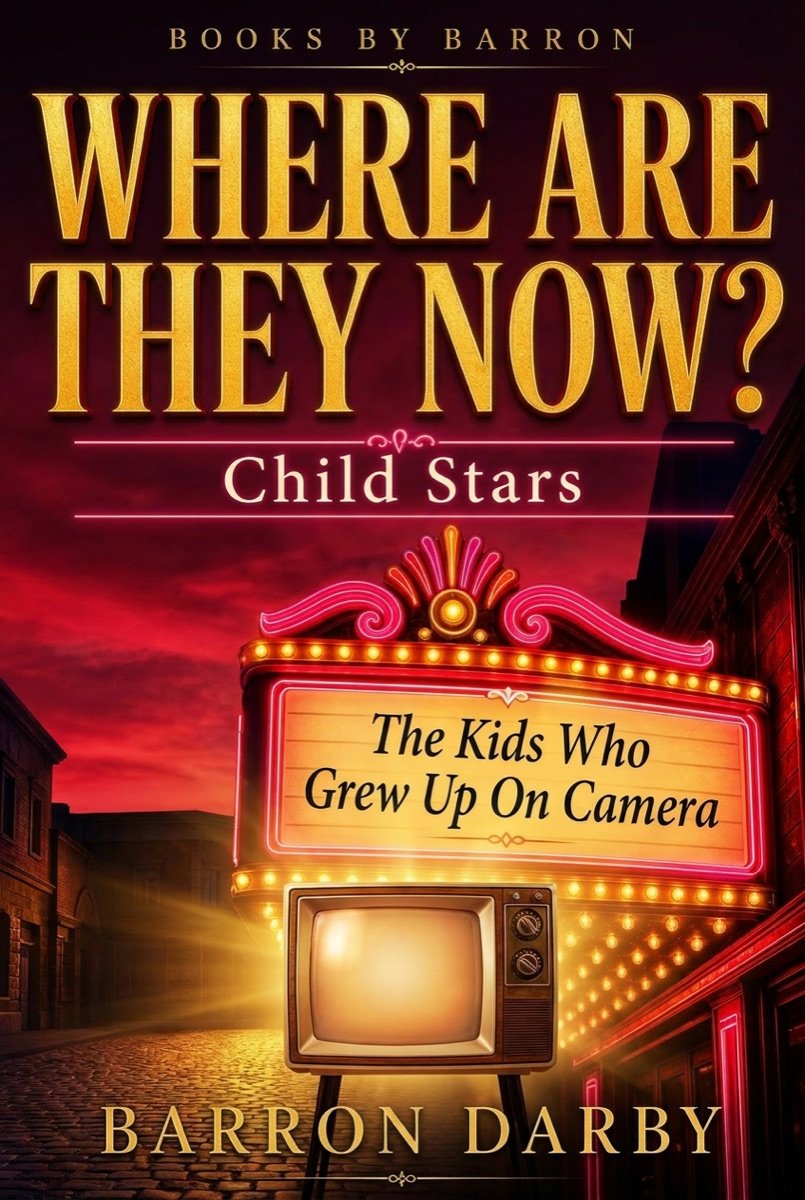
Where Are They Now? Child Stars


Payment Secure checkout by Stripe
Pay with Card, Google Pay, Cash App or Link
Format PDF + EPUB, no DRM
About this book
The Kids Who Grew Up On Camera
The Kids Who Grew Up On Camera.
A Where Are They Now? book. The fame is the part everybody remembers. This is the rest of it, told from public record, with dates, and without tidying the endings that did not tidy themselves.
Written by Barron Darby. Also available as a full audiobook on the Books By Barron channel.
Chapter One
A note on this book. It is a work of biography drawn entirely from public, published sources, and it profiles people who chose to live a part of their lives in front of us. It is written with affection and with respect. Where the public record is painful, this telling slows down and lowers its voice. Where a person has asked, in their own words, to be left alone or to be seen a certain way, this book honors that. Nothing here is invented. The point is not to gawk at who these people used to be. The point is to find out who they became, and to be a little kinder to the kid on the screen, now that we know what it cost.
Introduction. The Cost of Growing Up Famous.
Every one of us has a face we remember from childhood that was not a relative, not a neighbor, not a teacher. It was a face on a screen. A kid about our age, beamed into the living room every week, saying the lines we wished we were quick enough to say, living the life we watched from the couch with a bowl of cereal going soft in our hands. We grew up with those kids. And then, the way childhood does, it ended, and the screen moved on to other faces, and we got jobs and mortgages and gray hair, and somewhere in the back of the mind a question sat quietly for twenty or thirty years, waiting for somebody to ask it.
Whatever happened to them?
Here is the thing nobody tells you about being a famous child. The fame is not the hard part. The hard part is what happens to a person who peaks at twelve. Most of us get to be clumsy and awkward and wrong in private, in middle school hallways nobody filmed, and we get to grow out of it where no one is keeping score. A child star does not get that. A child star does their growing up on a public stage, and then, right around the age the rest of us are just getting started, the world quietly decides it is finished with them. Imagine being told, at nineteen, that the best and most important thing you will ever do is already behind you. Imagine the whole planet agreeing on it.
Some of them broke under that. We will be honest about the ones who did, because pretending otherwise would be a lie, and because their stories are the ones that teach us the most. But here is what surprises anyone who goes looking, the deeper they go. Most of them did not break. Most of them did something far more interesting and far harder than staying famous. They grew up. They walked away on purpose. They went to college, or started companies, or raised children, or learned, slowly and at real cost, how to be a whole adult after a childhood that was anything but normal. The comeback is a good story. But the quiet second act, the one where a former child star becomes a photographer or a watchmaker or a race car driver or simply a happy and private person, is the better one.
So let us go find them. The kids we grew up with. Let us find out where they are now.
We Begin With the One Who Started It All.
Before there were Disney factories or Nickelodeon machines, there were families who turned their children into stars, and we have to begin with the brightest and the saddest of them all, because his story is, in a way, the whole story, the reason a book like this needs to exist at all.
The Jackson 5 are where the whole conversation has to bow its head, because they gave us the most famous child star who has ever lived, and the most cautionary tale of all. Five brothers out of Gary, Indiana, drilled relentlessly by their father, exploded onto the scene at the turn of the 1970s, and at the center of them was a little boy named Michael, maybe ten or eleven, singing lead with a feeling no child should have access to, a voice that sounded like it had already lived three lifetimes. They were a phenomenon, I Want You Back, A B C, the screaming crowds, the lunchboxes, the cartoon. And here is the thing we cannot say lightly. Michael Jackson spent the rest of his life telling anyone who would listen that the price of that stardom was his entire childhood, that he never got to be a kid, that he was working when other children were playing, and that the hole it left in him never closed. He became the biggest entertainer in the history of the world, and he also became the living, breaking embodiment of the central wound of this whole book, the child who peaked before he grew, and who spent his adulthood trying, sometimes in ways the world found alarming, to reclaim a boyhood that had been taken from him. His life and his legacy remain the subject of enormous and painful public debate, and this book will not try to settle it. He died in 2009, at fifty, far too soon. We hold the complexity of him without resolving it, and we let the little boy with the impossible voice stand for the cost of all of it.
And where are his brothers now? Still here, mostly, still carrying the name. Jackie, Jermaine, and Marlon have continued to perform and to tend the family legacy across the decades. But the Jacksons, too, have learned that the screen does not promise old age, because in September of 2024 they lost Tito, the quiet brother, the guitarist, the steady one, who died suddenly at seventy, taken ill on a drive through New Mexico, with no official cause ever released. He had finally, late in life, stepped out front with his own blues music, the shy middle brother becoming a frontman in his own right in his sixties. His passing gathered the surviving family in grief once again. The Jackson 5 were the brightest child stars America ever produced, and their story holds, in one family, the whole spectrum, the dizzying height and the deepest cost and the long roll call of loss. We remember them with awe and with tenderness both.
Jaleel White.
For a generation, he was not a person. He was a sound. The snort of a laugh, the suspenders hiked to the ribs, the voice that could peel paint. Did I do that. Jaleel White played Steve Urkel on Family Matters, and the character was so enormous, so completely swallowing of everything around it, that for years the young man inside the costume could not get the rest of the world to see him at all.
Here is what people forget. Urkel was supposed to appear once. One episode, a one-time guest, the annoying neighbor kid. He tested through the roof, and within a season the show had quietly rebuilt itself around a twelve-year-old in horn-rimmed glasses. That is a staggering thing to put on a child, to make him the engine of a hit network show, and Jaleel White carried it for nine years. The cost was a familiar one. He has spoken, as an adult, about how completely the character erased him, how hard it was to be taken seriously as a grown actor when half the country still heard that snort the moment he walked into a room.
And where is he now? He did the wise thing. He stopped fighting the character and started building around it. He went to UCLA and graduated. He became a working voice actor, including a long run as the voice of Sonic the Hedgehog, which is a beautiful kind of full circle, a man known for one unforgettable voice making a whole second career out of his real one. He competed on Dancing with the Stars. He launched a cannabis brand. And in recent years he did the thing that takes the most courage of all. He wrote it down. He told his own story, in his own words, finally the author of the kid in the suspenders instead of his prisoner. The snort was never the whole of him. It just took the rest of us thirty years to find that out.
Soleil Moon Frye.
She was Punky Brewster, and if you are of a certain age, you can still see the mismatched sneakers, the bandana, the bright scrambled colors of a little girl who decided the world was going to take her exactly as she was. Soleil Moon Frye was a tiny powerhouse of optimism on 1980s television, and the remarkable thing about her story is how much of that optimism turned out to be real, and how it survived.
Most child stars lose the footage. Soleil did the opposite. As a teenager in the 1990s, moving through a Hollywood full of other famous kids, she did something almost nobody else thought to do. She carried a video camera everywhere and filmed it all, the parties, the heartbreaks, the friends who would and would not make it out. Decades later she opened those tapes and turned them into a documentary called Kid 90, and it is one of the most honest things ever made about what that particular childhood actually felt like from the inside. It is funny and it is devastating and it does not flinch.
Where is she now? She reprised Punky Brewster in a 2021 revival, a grown woman playing the grown-up version of the little girl who raised a generation. She is an author. She is a photographer with a real and serious eye. She is a mother of four, an advocate for the planet, and by every public account a person who took the strange gift of an early-camera childhood and made it into a tool for telling the truth. The little girl in the mismatched sneakers grew up to be the one holding the camera steady while everyone else looked away. That tracks. That tracks completely.
Raven-Symoné.
She arrived almost impossibly early. She was three years old on The Cosby Show, a toddler who could hold the screen against some of the biggest stars in television, and the camera simply loved her, the way it loves only a handful of people in a generation. By the 2000s she was the center of her own universe, That's So Raven, a Disney Channel juggernaut about a teenager who could see the future, and a whole cohort of kids grew up on her the way an earlier one grew up on Punky.
The future the show could never have predicted was her own. Raven-Symoné grew into a woman determined to define herself entirely on her own terms, and she did, loudly and sometimes against considerable pushback. She talked openly about her life and her identity on her own schedule and in her own words. She came back to the role that made her, in Raven's Home, this time playing the mother, the psychic teenager grown into a psychic mom, which is its own quiet kind of poetry. In 2020 she married Miranda Maday, and she has built a public life since that looks, more than anything, like a person who is finally comfortable. The toddler the camera loved spent her whole life being looked at. The adult decided she would be the one to say what we were looking at. After a childhood like hers, that is not vanity. That is survival, and it is hard-won.
Interlude. The Trick of the Frozen Face.
There is a strange cruelty built into the way we remember child stars, and it is worth naming before we go any further. We freeze them. In our minds they stay exactly the age they were when we loved them most. Kevin McCallister is eight, hands on his cheeks, forever. Mara Wilson is six, reading at the kitchen table in Matilda, forever. We are allowed to age. They are not.
And so when we finally see them as adults, there is this small involuntary jolt, almost an offense, as if they have done something to us by growing up. They have not, of course. They have only done the one thing every living person does. But it explains the whole strange industry of the where are they now, the thing you are listening to right now. We are not really asking where they went. We know where they went. They went into ordinary adult life, the same place we all go. What we are really asking is something more tender and more selfish at the same time. We are asking the child on the screen to tell us that the years did not hurt them too badly. We are asking them to be all right, partly for their sake, and partly, if we are honest, for our own.
Some of them are. Let us go see.
Did chapter one make you want chapter two?
This comes straight to me. No account, no purchase, nothing posted publicly.
A note on this book. It is a work of biography drawn entirely from public, published sources, and it profiles people who chose to live a part of their lives in front of us. It is written with affection and with respect. Where the public record is painful, this telling slows down and lowers its voice. Where a person has asked, in their own words, to be left alone or to be seen a certain way, this book honors that. Nothing here is invented. The point is not to gawk at who these people used to be. The point is to find out who they became, and to be a little kinder to the kid on the screen, now that we know what it cost.
Introduction. The Cost of Growing Up Famous.
Every one of us has a face we remember from childhood that was not a relative, not a neighbor, not a teacher. It was a face on a screen. A kid about our age, beamed into the living room every week, saying the lines we wished we were quick enough to say, living the life we watched from the couch with a bowl of cereal going soft in our hands. We grew up with those kids. And then, the way childhood does, it ended, and the screen moved on to other faces, and we got jobs and mortgages and gray hair, and somewhere in the back of the mind a question sat quietly for twenty or thirty years, waiting for somebody to ask it.
Whatever happened to them?
Here is the thing nobody tells you about being a famous child. The fame is not the hard part. The hard part is what happens to a person who peaks at twelve. Most of us get to be clumsy and awkward and wrong in private, in middle school hallways nobody filmed, and we get to grow out of it where no one is keeping score. A child star does not get that. A child star does their growing up on a public stage, and then, right around the age the rest of us are just getting started, the world quietly decides it is finished with them. Imagine being told, at nineteen, that the best and most important thing you will ever do is already behind you. Imagine the whole planet agreeing on it.
Some of them broke under that. We will be honest about the ones who did, because pretending otherwise would be a lie, and because their stories are the ones that teach us the most. But here is what surprises anyone who goes looking, the deeper they go. Most of them did not break. Most of them did something far more interesting and far harder than staying famous. They grew up. They walked away on purpose. They went to college, or started companies, or raised children, or learned, slowly and at real cost, how to be a whole adult after a childhood that was anything but normal. The comeback is a good story. But the quiet second act, the one where a former child star becomes a photographer or a watchmaker or a race car driver or simply a happy and private person, is the better one.
So let us go find them. The kids we grew up with. Let us find out where they are now.
We Begin With the One Who Started It All.
Before there were Disney factories or Nickelodeon machines, there were families who turned their children into stars, and we have to begin with the brightest and the saddest of them all, because his story is, in a way, the whole story, the reason a book like this needs to exist at all.
The Jackson 5 are where the whole conversation has to bow its head, because they gave us the most famous child star who has ever lived, and the most cautionary tale of all. Five brothers out of Gary, Indiana, drilled relentlessly by their father, exploded onto the scene at the turn of the 1970s, and at the center of them was a little boy named Michael, maybe ten or eleven, singing lead with a feeling no child should have access to, a voice that sounded like it had already lived three lifetimes. They were a phenomenon, I Want You Back, A B C, the screaming crowds, the lunchboxes, the cartoon. And here is the thing we cannot say lightly. Michael Jackson spent the rest of his life telling anyone who would listen that the price of that stardom was his entire childhood, that he never got to be a kid, that he was working when other children were playing, and that the hole it left in him never closed. He became the biggest entertainer in the history of the world, and he also became the living, breaking embodiment of the central wound of this whole book, the child who peaked before he grew, and who spent his adulthood trying, sometimes in ways the world found alarming, to reclaim a boyhood that had been taken from him. His life and his legacy remain the subject of enormous and painful public debate, and this book will not try to settle it. He died in 2009, at fifty, far too soon. We hold the complexity of him without resolving it, and we let the little boy with the impossible voice stand for the cost of all of it.
And where are his brothers now? Still here, mostly, still carrying the name. Jackie, Jermaine, and Marlon have continued to perform and to tend the family legacy across the decades. But the Jacksons, too, have learned that the screen does not promise old age, because in September of 2024 they lost Tito, the quiet brother, the guitarist, the steady one, who died suddenly at seventy, taken ill on a drive through New Mexico, with no official cause ever released. He had finally, late in life, stepped out front with his own blues music, the shy middle brother becoming a frontman in his own right in his sixties. His passing gathered the surviving family in grief once again. The Jackson 5 were the brightest child stars America ever produced, and their story holds, in one family, the whole spectrum, the dizzying height and the deepest cost and the long roll call of loss. We remember them with awe and with tenderness both.
Jaleel White.
For a generation, he was not a person. He was a sound. The snort of a laugh, the suspenders hiked to the ribs, the voice that could peel paint. Did I do that. Jaleel White played Steve Urkel on Family Matters, and the character was so enormous, so completely swallowing of everything around it, that for years the young man inside the costume could not get the rest of the world to see him at all.
Here is what people forget. Urkel was supposed to appear once. One episode, a one-time guest, the annoying neighbor kid. He tested through the roof, and within a season the show had quietly rebuilt itself around a twelve-year-old in horn-rimmed glasses. That is a staggering thing to put on a child, to make him the engine of a hit network show, and Jaleel White carried it for nine years. The cost was a familiar one. He has spoken, as an adult, about how completely the character erased him, how hard it was to be taken seriously as a grown actor when half the country still heard that snort the moment he walked into a room.
And where is he now? He did the wise thing. He stopped fighting the character and started building around it. He went to UCLA and graduated. He became a working voice actor, including a long run as the voice of Sonic the Hedgehog, which is a beautiful kind of full circle, a man known for one unforgettable voice making a whole second career out of his real one. He competed on Dancing with the Stars. He launched a cannabis brand. And in recent years he did the thing that takes the most courage of all. He wrote it down. He told his own story, in his own words, finally the author of the kid in the suspenders instead of his prisoner. The snort was never the whole of him. It just took the rest of us thirty years to find that out.
Soleil Moon Frye.
She was Punky Brewster, and if you are of a certain age, you can still see the mismatched sneakers, the bandana, the bright scrambled colors of a little girl who decided the world was going to take her exactly as she was. Soleil Moon Frye was a tiny powerhouse of optimism on 1980s television, and the remarkable thing about her story is how much of that optimism turned out to be real, and how it survived.
Most child stars lose the footage. Soleil did the opposite. As a teenager in the 1990s, moving through a Hollywood full of other famous kids, she did something almost nobody else thought to do. She carried a video camera everywhere and filmed it all, the parties, the heartbreaks, the friends who would and would not make it out. Decades later she opened those tapes and turned them into a documentary called Kid 90, and it is one of the most honest things ever made about what that particular childhood actually felt like from the inside. It is funny and it is devastating and it does not flinch.
Where is she now? She reprised Punky Brewster in a 2021 revival, a grown woman playing the grown-up version of the little girl who raised a generation. She is an author. She is a photographer with a real and serious eye. She is a mother of four, an advocate for the planet, and by every public account a person who took the strange gift of an early-camera childhood and made it into a tool for telling the truth. The little girl in the mismatched sneakers grew up to be the one holding the camera steady while everyone else looked away. That tracks. That tracks completely.
Raven-Symoné.
She arrived almost impossibly early. She was three years old on The Cosby Show, a toddler who could hold the screen against some of the biggest stars in television, and the camera simply loved her, the way it loves only a handful of people in a generation. By the 2000s she was the center of her own universe, That's So Raven, a Disney Channel juggernaut about a teenager who could see the future, and a whole cohort of kids grew up on her the way an earlier one grew up on Punky.
The future the show could never have predicted was her own. Raven-Symoné grew into a woman determined to define herself entirely on her own terms, and she did, loudly and sometimes against considerable pushback. She talked openly about her life and her identity on her own schedule and in her own words. She came back to the role that made her, in Raven's Home, this time playing the mother, the psychic teenager grown into a psychic mom, which is its own quiet kind of poetry. In 2020 she married Miranda Maday, and she has built a public life since that looks, more than anything, like a person who is finally comfortable. The toddler the camera loved spent her whole life being looked at. The adult decided she would be the one to say what we were looking at. After a childhood like hers, that is not vanity. That is survival, and it is hard-won.
Interlude. The Trick of the Frozen Face.
There is a strange cruelty built into the way we remember child stars, and it is worth naming before we go any further. We freeze them. In our minds they stay exactly the age they were when we loved them most. Kevin McCallister is eight, hands on his cheeks, forever. Mara Wilson is six, reading at the kitchen table in Matilda, forever. We are allowed to age. They are not.
And so when we finally see them as adults, there is this small involuntary jolt, almost an offense, as if they have done something to us by growing up. They have not, of course. They have only done the one thing every living person does. But it explains the whole strange industry of the where are they now, the thing you are listening to right now. We are not really asking where they went. We know where they went. They went into ordinary adult life, the same place we all go. What we are really asking is something more tender and more selfish at the same time. We are asking the child on the screen to tell us that the years did not hurt them too badly. We are asking them to be all right, partly for their sake, and partly, if we are honest, for our own.
Some of them are. Let us go see.
Follow the reading and listening instructions beside the cover to continue with the whole book.