Chapter one is read by Brian. To hear the rest, buy the eBook, open the EPUB in the free ElevenReader app, and pick a voice. The whole book, read to you.
There is a morning every author knows. The book went live the night before, and you wake up and reach for the phone before you reach for anything else, and you open the dashboard. It has a graph on it. The graph is flat. You tell yourself it is early, which is true, and you tell yourself the store takes time to list a new title, which is also true, and you go and make coffee. By the end of the week the graph is still flat and the two true things have stopped helping.
I have had that morning more than seventy times. The last time I counted, there were ninety-seven tiles on the books page of my own site, some of them duplicates the page keeps for its scroller, and every one of those tiles was a morning like that. So I want to begin by taking the morning apart, because the mistake in it is not the one you think. The mistake is not that you expected too much. The mistake is that you thought publishing was one thing, when it is six.
THE SIX STATES OF A BOOK
A book can be in six different states, and they look the same from the dashboard.
The first state is published. The book exists. The file was accepted, the ISBN is attached, the word Live appeared. That is a real achievement and most people who say they are writing a book never reach it. It is also, by itself, worth nothing to a stranger, because a stranger does not know it happened.
The second state is distributed. Stores can sell it. Amazon lists it, the print-on-demand printer will make a copy if anyone orders one, the library supplier has it in the catalogue. KDP tells authors that a new title appears on its stores around the world in 72 hours, and that is true, and on the seventy-third hour the book is distributed to a planet that has not been told.
The third state is available. A reader could obtain it. The price is set, the buy button works, the sample is up, the paperback ships. If a reader somehow arrived at the page this afternoon with money and intent, nothing would stop them. Published, distributed, available. Most of us get all three of those done in a week, and then we wait for the graph, because we believe the fourth state follows from the third. It does not.
The fourth state is discoverable. A potential reader encounters the book. Not could encounter it; does. Somebody who did not know it existed at breakfast knows it exists by lunch, because something put it in front of them. A friend's message, a video, a search result, a face-out copy on a table, a post that was not an advertisement. This is the state where almost every independent book fails, and it fails silently, because nothing on the dashboard measures it. There is no column for strangers who never came.
The fifth state is compelling. The reader who encountered it became interested. The cover stopped them, the title made them curious, the description sounded like something they wanted. This state is measurable, barely, in clicks, and chapter seven is about the five things that have to do their job here before your writing gets a turn.
The sixth state is convertible. Interest turned into reading or buying. The sample got opened, the button got pressed, the book got read to the end, and, in the best case, the reader came back for the next one. That is the state the graph measures. It is the only state the graph measures, which is why a flat graph tells you so little. It tells you the sixth door did not open. It cannot tell you whether the fourth one was ever found.
An author can succeed completely at the first three states and fail completely at the last three, and from the inside it feels like one failure. It is not. It is three different jobs that have not been done yet, and they are the jobs this book is about.
THE BOOK THAT WAITED FOUR YEARS
I want to show you what the gap between available and discovered looks like at full size, because it is easy to think the gap only exists for people like me, with a small shelf and no publisher. It exists for everybody.
Adam Silvera published a young adult novel in 2017 with a premise you can say in one sentence: two boys get a call telling them they will die today, and they spend the day together. It was published by a real house, distributed everywhere, available at every price and in every format, and reviewed. For four years it was, in the terms I have just given you, in the third state. Then readers on TikTok started making short videos about it, crying on camera, holding the book up, and in April 2021 it went to the top of the New York Times young adult paperback list, according to NBC. The hashtag with the book's title had 37 million views by then. Tubefilter, reporting NPD BookScan's numbers, put its 2021 sales at 685,000 copies in the United States alone, and The Bookseller reported that in the United Kingdom it sold 100,000 copies in 2022 and spent nine weeks at number one on the young adult chart. The author did nothing new. The book did nothing new. What changed was the fourth state. Strangers began to encounter it, by the thousand, because other strangers put it in front of them.
Madeline Miller's case is the same shape with a longer wait. The Song of Achilles won the Orange Prize in 2012. Nine years later, in March 2021, Shelf Awareness reported it was selling about 10,000 copies a week, roughly nine times its rate in the year it won the prize, and the video doing the work was a reader's list of books that will make you sob, with nearly six million views. Tubefilter, again on NPD BookScan's count, put the book at 650,000 copies in 2021, the fourth bestselling adult fiction title of the year. A prize-winning novel from a major publisher sat available for nine years, and then was discovered.
Kristen McLean, who runs the book analysis at NPD BookScan, said it plainly to Tubefilter in January 2022: BookTok gets excited about a book, the retailers pay attention, merchandise it, other people find it. Notice the order. Discovery came first, and the stores followed it. Being on the stores for nine years had not caused it. NPR described the people making those videos as mostly young women, and I will come back to who the audiences were, case by case, because it matters more than the platform does.
I am not telling you those two stories so you will wait nine years for a video. I am telling you them because they are the cleanest proof I could find that the first three states do not cause the last three. If they did, a prize winner from a major house would not have needed a stranger with a phone.
THE QUESTION YOU CANNOT ANSWER WITH A STORE
Here is the exercise, and it is the only one in this chapter, so do it before you read on.
How would a complete stranger discover your book today?
Not a friend, not your sister, not somebody who follows you already. A stranger. Somebody who woke up this morning not knowing your name. Walk them from their breakfast table to your book's page, step by step, and name the thing that happens at each step.
The answer you are not allowed to give is Amazon. Or any store. The store is where the book lives. It is the third state. The question is asking about the fourth, and the fourth is about cause. What causes the stranger to encounter it? Bowker counted more than 3.5 million self-published titles with ISBNs in 2025 alone, and the Kindle store, by one published estimate, holds roughly 12 million titles, so a book that is merely in the store is a book in a warehouse with the lights off. Something has to carry a stranger to the shelf and turn their head. If you can name that something, you have a discovery plan, even if it is a weak one, and the rest of this book will make it stronger. If you cannot name it, you have what I had.
I will tell you what I had, because this book is a test case as much as a guide, and the test has to start with an honest reading. In the last week of September 2026 I asked myself that question about my own shelf and the true answer was: I do not know. I had a website and a channel and I posted the covers when they came out, and I could not describe the path a stranger would take to any one of the ninety-seven. The number that proved it was the zero in my sales report. Not zero stars, zero sales to anyone who did not know me, across more than seventy published titles, for about nine months. A stranger could have bought any of them any day. None did, because none were caused to arrive.
WHAT THE REST OF THE BOOK DOES
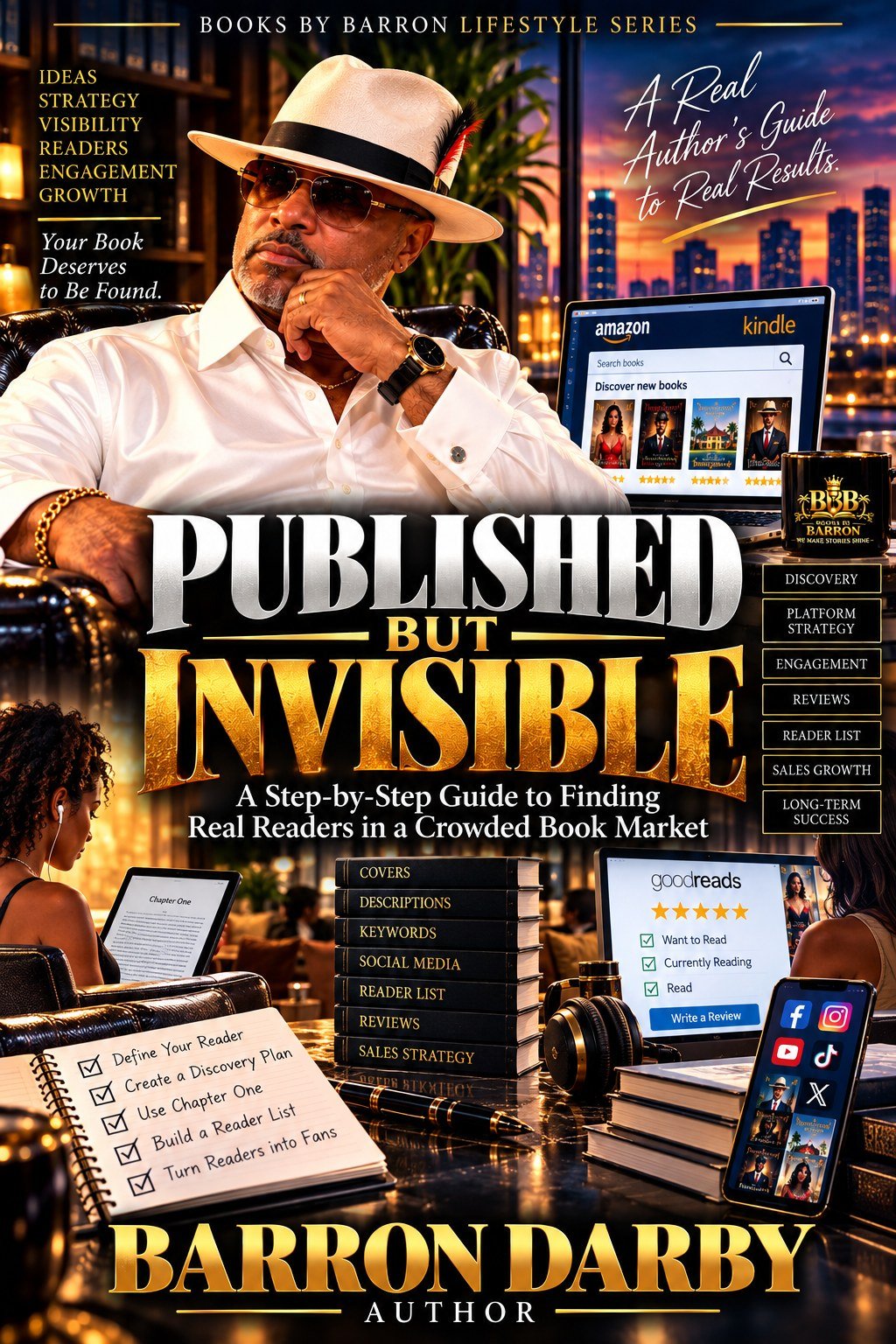
The notebook on the cover of this book has five lines on it and they are the map. Define your reader, which is Part Two, because you cannot cause a stranger to arrive until you can say which stranger. Create a discovery plan, which is Part Three and the thirty days in the middle of the book, because a plan is a path from their breakfast table to your page with a cause at every step. Use chapter one, which is the heart of Part Three, because the thing a stranger will do for you is not buy a book, it is spend four minutes finding out whether they want to. Build a reader list, which is Part Six, because a stranger you have found once should never have to be found twice. And turn readers into fans, which is the end of the book, because the second book is easier than the first only if the first reader is still in the room.
Between those, Part Four is about the four places where the twenty three authors in this book were found, TikTok, Instagram, YouTube and Facebook, told by what worked for whom. Part Five is about the people who will email you now that you are published. Part Seven is about measuring, which is the thing I did not do for nine months and the thing I will not stop doing now.
Every chapter from here ends the same four ways, and the fourth is the one that makes this a different kind of book. Something to do today. Something to do this week. Something not to do. And one number to write down, before and after, so that a month from now you know what caused the result instead of guessing.
DO THIS TODAY
Write one sentence that begins, A stranger would discover my book by, and finish it without using the name of a store. If you cannot finish it, write that down instead, in those words: I do not know. That sentence is worth more than a hopeful one, because it is the reading on the instrument and the rest of the book is built to change it.
THIS WEEK
Open every place your book is listed, the stores, the subscription library, the review site, your own site if you have one, and beside each one write which of the six states it reaches. Most will reach the third. Note the ones that reach the fourth, where a stranger could actually encounter the book without already looking for it, and note how few there are.
DON’T DO THIS
Do not answer the stranger question with the name of a store, a hashtag, or the word everywhere. Those are places the book sits. The question asks what moves a person, and a place does not move anyone. If the only honest answer is that nothing does, that is the answer to write down.
MEASURE THIS
Count the places a stranger could encounter your book this week that are not a store page: a post that is not an advertisement, a video, a sample on your site, a mention by somebody who is not you. Write the count down with the date. For most of us the first time it is counted the number is zero or one, and that number is the one every later chapter is trying to move.
That is chapter one.
Read the rest, or open the EPUB in ElevenReader and keep listening.
BUY THE EBOOK