
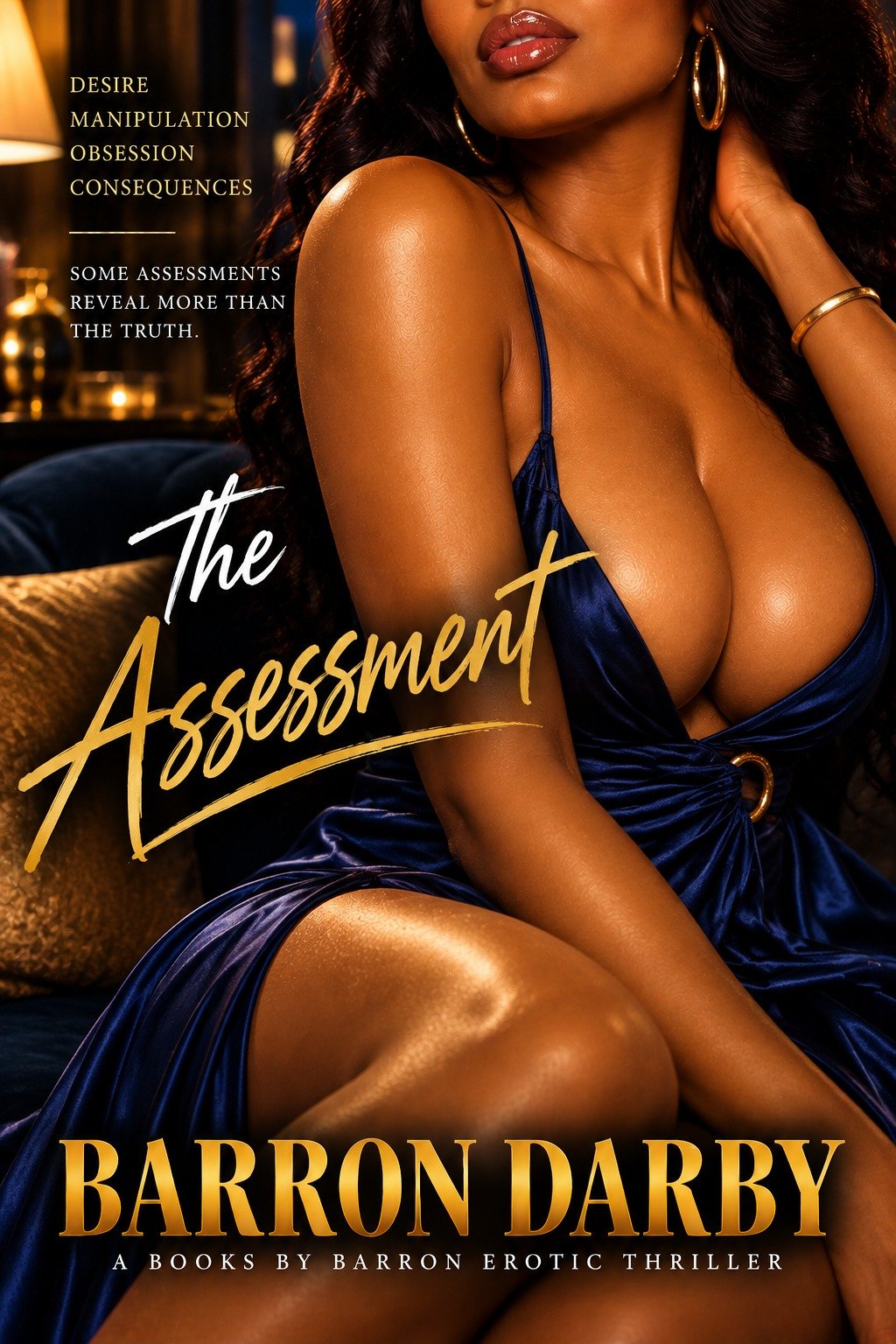
The Assessment
The math was honest. The calendar was not.
Written by Barron Darby
Paperback ISBN 979-8-953029-06-3 · Books By Barron
On a Friday in May, every house on one block of Savannah’s Tallow Ward receives a notice of assessment raising its value by four hundred and twelve percent. The owners have forty five days to appeal. Each of them had a purchase offer in the mailbox the week before.
Vernon Grimball has run the county’s real property division for twenty two years on one principle, which is that his numbers hold up. This one does. He checks the model three ways and the model is clean. What is not clean is the file it was built from, and Vernon knows where to look because he was shown the Tallow Ward before anyone told him it was being revalued.
Maudelle Polite is a retired accountant who has beaten his office twice, and who is rebuilding the county’s model from public records on the dining table of a house her grandmother bought in 1946. She has no reason on earth to trust him.
Neither of them understands yet that the assessment is not about taxes. A number on a notice is evidence in a hardship affidavit, a hardship affidavit is a demolition permit, and enough demolition permits will end a federal finding that has protected the ward since 2019. The block is not being priced. It is being disqualified. They have until the appeal window closes, and what neither of them knows is that the finding they are trying to save lapsed on the record fourteen months ago, and a lapse cannot be undone.
Chapter One
Chapter one is read by Morgan. To read or listen to the whole book, buy the eBook and follow the reading and listening instructions beside the cover.
The old man had folded the notice into quarters, then into eighths, and he pushed it across the counter that way, a thick little square of county paper with the creases gone soft.
“Open it,” Cleve Manigault said. “I want to watch somebody else open the thing.”
Vernon Grimball unfolded the square. The counter between them was the low one at the west end of the room, the one with a chair. The high counter was for people who would be standing ninety seconds. The low one was for everybody else.
He got the notice flat, put two fingers on the corner to hold it down, brought his reading glasses out of his hair and down onto the end of his nose.
Parcel identification. Owner of record, MANIGAULT, CLEVE R AND ROSALEE H. Property address, 209 Tallow Street, Savannah, Georgia. Previous year fair market value, one hundred and nine thousand four hundred. Current year fair market value.
He read the current year twice.
“Five hundred and sixty one thousand,” Cleve said. “You don’t have to say the number. I said it about forty times last night.”
“Mr. Manigault.”
“Rosalee thought it was a mistake in the printing. She said they put somebody else’s number in our box.” Cleve had his hat in his hands, a straw hat with the brim gone wavy, and he turned it a quarter turn. “I told her the county doesn’t print the wrong number. The county prints the number it means.”
True. Vernon had said it himself, in this room, more times than he could count, and hearing it come back at him in an eighty year old longshoreman’s voice turned something over under his breastbone.
“Give me a minute,” he said.
He went to the terminal at the end of the counter, the public one. He did not want to walk back into the office and leave the man standing there.
He pulled the parcel. Then he pulled the neighbours.
207 Tallow, previous one hundred and two thousand, current five hundred and eighteen.
211 Tallow, ninety eight, current five hundred and four.
213. 217. 221. Then 205, a vacant lot with a slab on it behind chain link, up from nineteen thousand to two hundred and forty one.
He scrolled. The screen gave him the block in a column, and the column did not break. Nineteen parcels between Duffy and the lane. Every one of them. Not one under four hundred percent.
He put his hand flat on the counter beside the keyboard, wanting something under it that was not moving.
“Mr. Grimball.” Cleve had come down the counter, hat still in his hands. “You want to know what I paid for that house.”
“I know what you paid for that house. It’s in the file.”
“Fourteen thousand dollars in nineteen and seventy three. Twenty five years old, a job on the docks, a wife, and I paid fourteen thousand dollars.” He set the hat on the counter, crown down, the way a man sets a hat down when he has decided to stay. “Tell me what happened between last May and this May that made my house worth five and a half.”
“I don’t know yet.”
“That’s not an answer.”
“No, sir,” Vernon said. “It isn’t.”
Behind him the office had the sound it had every year in the second week of May, which was the sound of a building full of telephones being answered. Notices had gone out Friday. Today was Monday. On the far side of the partition Loretta was saying, for the fourth time since eight o’clock, that no ma’am, the notice was not a bill, the bill came in the fall. That yes ma’am, there was an appeal. That the date to remember was the twenty third of June.
Forty five days from the date on the notice. Not forty five business days. Not forty five days from when you opened the envelope, or from when your son got home and explained it to you. Forty five days from the ninth of May, and on the twenty fourth the door shut for a year.
“You got a pen?” Cleve said.
“For what?”
“To write down what I do next.”
Vernon took a pen out of his shirt pocket, pulled a claim form off the stack, turned it around. He wrote the deadline across the top in block capitals and underlined it twice. Under the deadline he wrote his own extension, which was not something he did, and slid the form across.
“You call that number and ask for me. Not the general line. Me.”
Cleve looked at the paper a long moment. He had a way of reading with his chin down that made it look like he was deciding whether to believe the page.
“Twenty two years you been in here,” he said.
“Twenty two years.”
“My daddy knew your granddaddy out on Sapelo.”
“I know.”
“So I’m going to ask you like that.” Cleve picked up his hat. “Is this the county, or is this something else wearing the county’s clothes.”
The room went on being loud around them. Somebody’s phone was ringing with a hymn in the ringtone. Loretta said the twenty third of June.
“Ask me in a week,” Vernon said.
“That’s not an answer either.”
“It’s the one I’ve got.”
The old man put his hat on, squared it, went out through the double doors into the light on Oglethorpe Avenue. Vernon stayed at the public terminal with nineteen parcels on the screen and the taste of pennies at the back of his mouth.
He did not go back to his office. He went down the hall to the print room where the wide format machine was, and ran the block out on paper. He wanted to hold the block in his hands.
The sheet came out warm. He laid it on the table, put his glasses down, went along the column with the cap of the pen, parcel by parcel. At the bottom of the sheet, in the header the machine stamped on everything it printed because somebody had configured it that way in 2011 and nobody had ever turned it off, ran a line of small type.
SOURCE: CAMA_RES_EXPORT. RUN 05/12/2025 08:41.
Under it, since every export the county produced carried its provenance, a second line nobody read.
SALES FILE LOAD 09/04/2024.
Vernon’s eye went across the line, stopped, went on, the way an eye goes across type it has read ten thousand times.
“Mr. Grimball.” Brice Toombs’ regional coordinator stood in the doorway with a binder against her hip. “You have a second on the personal property schedule.”
“I have a second.”
He folded the sheet in half along the column, carried it back to his office, put it under the blotter. Then he went to talk about personal property.
* * *
The defence memo was on his desk at two o’clock, faster than it had any right to be.
Three pages. Already signed by Celestine Hardwick in the county attorney’s office, a small precise signature with no flourish in it, and a tab flag where Vernon’s line went. The heading said TALLOW WARD 2025 REVALUATION, ANTICIPATED APPEALS, POSTURE.
He read it standing up.
It said the Tallow Ward revaluation had been produced by the county’s mass appraisal model in the ordinary course. It said the model had been calibrated and tested, its results inside acceptable parameters. It said the county would defend the values on appeal, that no administrative rollback was contemplated. In the last paragraph it said the Real Property Division had reviewed the affected parcels and concurred.
The Real Property Division had not reviewed the affected parcels. The Real Property Division had spent the morning at the low counter with a man in a straw hat.
Vernon put the memo on the blotter, on top of the folded sheet, and looked at the tab flag.
Every word in it was probably true. He kept turning the sentence over. He had signed a hundred of these and meant every one. He had built his whole standing in that building on the fact that when his name went on a number, the number held. Twenty two years. Three chief appraisers over him, all three of whom had learned to let him alone. In 2013 a lawyer from Atlanta came down to take a ninety parcel commercial appeal apart in front of the board, and left at four in the afternoon having taken nothing apart at all. For a year afterward people in that office said Grimball’s numbers the way you would say a brand of tool.
The values were probably right. The model was probably clean. He could sign this page and be correct.
He picked up his pen, put the point on the paper, held it there.
Four hundred and twelve percent. Nineteen parcels. Not one outlier low, not one outlier high, the whole block moving together like a thing decided rather than a thing measured.
Markets did not behave that way. Markets came out ragged. A block where somebody had put a new roof on, somebody else had let the porch go, somebody else had died in March with the heirs arguing, came out ragged, always, every time. The raggedness was how you knew you were looking at a market instead of a decision.
He took the point off the paper.
He unclipped the tab flag, set it on the corner of the desk, put the memo in his out tray unsigned. Then he stood looking at his out tray. An unsigned memo in an out tray was a memo somebody would pick up and carry to somebody else. He took it back and put it in the drawer.
* * *
He was still there at ten past six when Irena Mazur came past his door with her coat on, her bag already over her shoulder.
“Point nine one,” she said.
“Good evening to you as well.”
“Point nine one.” She came in two steps, not all the way. She had a puffer vest on under the coat, as she did indoors from October to June. Her hair was grown out unevenly on one side from a cut in March she had never gone back to finish. “Ratio study. Tallow Ward, if the new values stand and the four spring sales hold. Assessment to sales. Point nine one.”
Vernon sat back.
“That’s fine,” he said.
“That’s better than fine. That’s the best ratio in the county on a residential block that size. The rest of the west side runs point eight three, and everybody is happy with point eight three.” She shifted the bag. “So whatever it is you have got that face on about, the model is not the problem. The model is the cleanest thing I have built in four years. I ran it three ways. Without the outliers it barely moved.”
“What outliers.”
“There aren’t any. I am telling you there is nothing to throw out.”
She stood in the doorway with her coat open. Behind her the hall lights had gone to the half setting they went to at six, so that half the ceiling was lit and half was dark all the way down. The office had the particular deadness of a public building after the public has gone.
“Irena. When did the sales file load.”
“Which sales file.”
“The residential file the ward ran against.”
“Whenever we load it. February, March.” She frowned. “It’s the same file everything ran against. Why.”
“No reason.”
“You said a thing, then you said no reason, which is a sentence that has never once been true.” She waited. He did not fill the silence. She adjusted the bag. “Point nine one,” she said. “Go home.”
He heard the stairwell door on the landing, then nothing.
Vernon sat a while with the drawer shut on the unsigned memo, the blotter square in front of him, the folded sheet underneath. At twenty to seven he turned off the lamp. He went out through the half lit hall and down onto Oglethorpe Avenue, where the light was doing what it did in Savannah in May, coming in flat and gold under the live oaks, picking out every piece of Spanish moss separately. Across town a whole block of people sat at their kitchen tables with a piece of county paper in front of them, working out what they were going to have to sell.
* * *
Notice week ran the phones from eight in the morning until the doors shut, and by the Wednesday the counter staff had stopped saying hello and started saying the date.
Vernon came out of his office at half past nine, stood at the end of the partition, and watched the room work. He did it every year and nobody had ever remarked on the habit.
Six desks. Loretta on the end one, because Loretta took the ones that had been transferred twice.
“No ma’am, the notice is not a bill. The bill comes in the fall from the tax commissioner and it is a different office and a different envelope.” She had her glasses up on her head and a pencil behind her ear she had not used all morning. “Yes, ma’am. Yes, ma’am, I know. The twenty third of June.”
At the third desk a young man named Marquis was explaining a homestead exemption to somebody for the fourth time and getting kinder each time, which was rare and which Vernon had noticed in March and written down.
At the second desk a woman was crying.
Not the caller. The clerk.
Vernon went along behind the desks without hurrying and put two fingers on the back of her chair, and she put the call on hold and took her headset half off.
“I’m all right.”
“Rhonda.”
“I am all right, Mr. Grimball, it is a Wednesday in May and I have been doing this for nine years.” She wiped under one eye with the heel of her hand, once, efficiently. “That was a man on Waters Avenue. He is seventy four. He wanted me to tell him it was a mistake and I told him it was not a mistake, and he said thank you for your time, ma’am, and I could hear his wife in the room.”
“Take fifteen minutes.”
“I do not want fifteen minutes.”
“Take them anyway,” Vernon said. “You will be back at ten and you will do four more hours, and if you do not take them you will do two.”
She went. Loretta watched her go and then looked up at him over the glasses that were on top of her head.
“Tallow Street,” Loretta said.
“Say the rest.”
“Eleven calls since Monday out of nineteen households, which is high, and four of them have called twice.” She turned her pad around. “And three of them have asked me the same question, which nobody ever asks.”
Vernon looked at the pad.
“Which question.”
“Whether anybody else on their street got one.”
He stood at the end of the counter with his hand on the back of an empty chair.
In twenty two years of notice weeks he had heard every question the public knows how to ask. Is it a bill. Can you fix the number. What is the millage. Do I have to pay while I appeal. Who decided the figure. Why is my neighbour’s lower.
Why is my neighbour’s lower was the commonest question in that building, and it had been asked at that counter about four hundred thousand times, and it was the question that mass appraisal existed to answer.
Nobody had ever walked in and asked whether the whole street had got a notice.
“Loretta.”
“Mm.”
“When they ask you that, what do you tell them.”
“I tell them the truth, which is that I cannot discuss another taxpayer’s parcel, and then I tell them the other truth, which is that it is all on the public portal and here is the address.” She wrote something. “And every single one of them has said the same thing back to me.”
“What.”
“They have said, I know, I already looked,” Loretta said. “Which means they looked first, and then they called, and they did not call to ask. They called to have somebody say it out loud.”
To read or listen to the whole book, buy the eBook and follow the reading and listening instructions beside the cover.
Paperback ISBN 979-8-953029-06-3 · Books By Barron
Paperback ISBN 979-8-953029-06-3 · Books By Barron