
Kindle, paperback and hardcover editions on Amazon
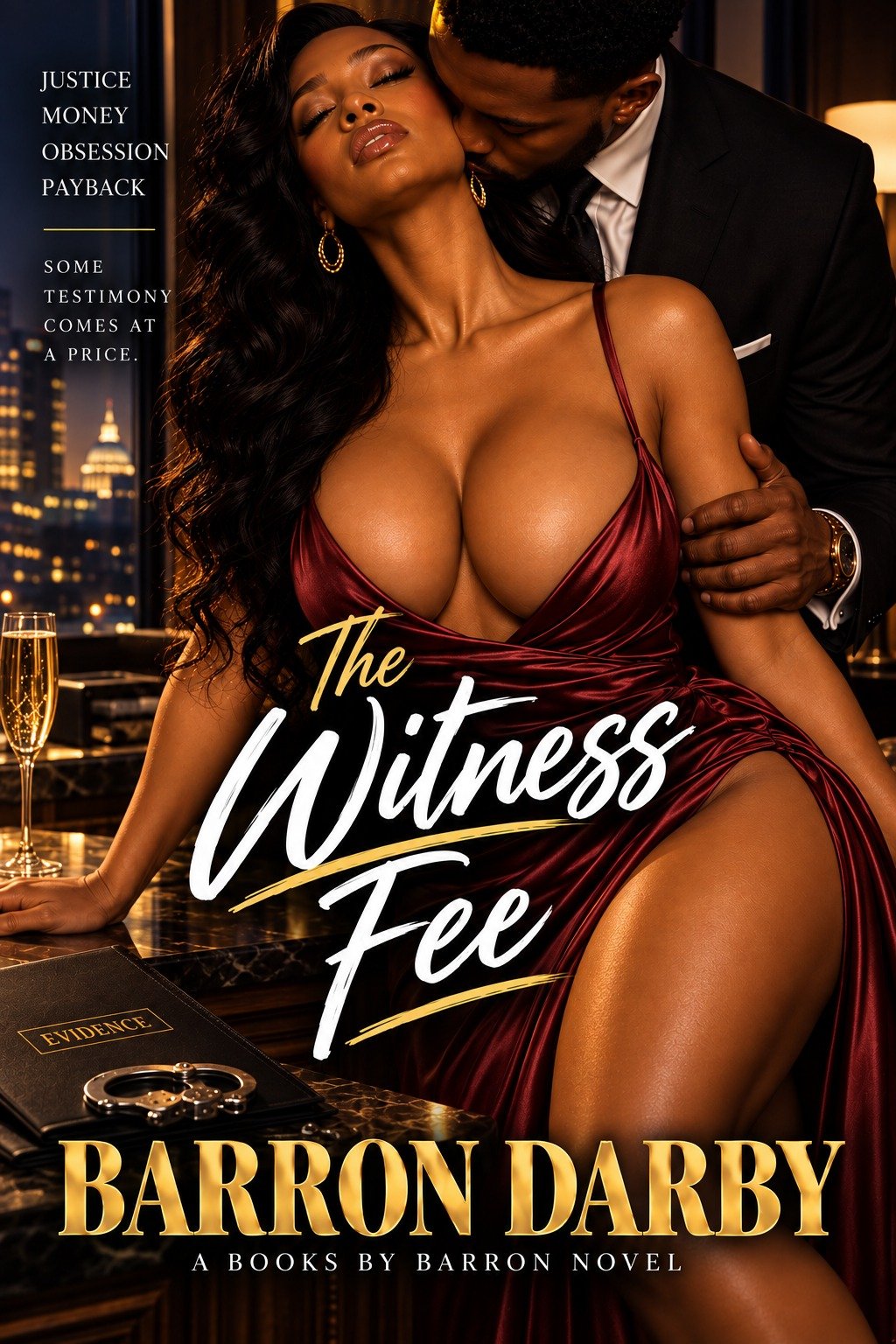
The Witness Fee
A Phoenix Erotic Thriller
Written by Barron Darby
Paperback ISBN 979-8-953029-28-5 · Books By Barron
Doctor Wesley Karim has testified three hundred and forty times and has never once been excluded. That record is his whole practice.
At twenty minutes past six on a Monday morning in June he finds a photograph in his own case file: a hundred and thirty-one feet of black rubber on a wet freeway shoulder. He has measured that skid eleven times, in eleven unrelated cases, across nine years. The arithmetic is correct every time. The road is not.
It was never a forgery. It was a calibration, run at a proving ground on a morning in June, photographed to evidentiary standard, and dropped into eleven case files by a job that runs at fourteen minutes past nine. It did not need to fool a jury. It needed one witness nobody could move.
To prove what was done to him, Wesley will have to say out loud what he has spent four years not saying to his own wife: that he has not stood at a crash scene since the morning he went down a canal embankment with a survey rod in his hand. Saying it costs a young engineer his license, a practice with eleven people in it, and the seal Wesley has carried since 1998.
A young defense associate has the same eleven files on the floor of a war room, and no idea yet that she was handed them. And somewhere in it is a man who did the arithmetic in 2016, and was right, and is still right.
Chapter One
Chapter one is read by Morgan. To keep reading, buy the Kindle edition on Amazon.
The office was cold enough at 5:40 in the morning that Wesley Karim worked with his suit jacket still on, and the photograph on the left screen had been open for eleven minutes before he saw the skid.
He had been looking at the box truck. That was the assignment. Loop 202 westbound, the second of March, wet surface, a lane change out of the number three that a jury would be asked to call reckless or call ordinary depending on which report they believed. Wesley had written the report that said ordinary. He had signed it on the twenty-second of May and invoiced eleven thousand four hundred dollars for it, the invoice had cleared, and there had been nothing in the file on the twenty-second of May that made him sit forward the way he was sitting forward now.
The skid ran out of the bottom left of the frame and died under the truck’s rear axle. Black, continuous, unbroken for its whole length, laid down by a tire that had locked and stayed locked, the vehicle that had laid it was a 2019 crossover with four-channel antilock brakes that had been tested and found working by the fire company on scene.
An antilock system does not let a tire lock. It cannot. That is the entire purpose of an antilock system. What it leaves on wet asphalt is a broken scuff, a stutter, a mark that goes light and dark and light again at ten or twelve cycles a second, any reconstruction engineer who has been at this for thirty years can pick it out of a photograph at a glance, because it is the most common thing there is.
Wesley zoomed until the black went to gray pixels and the pixels went to squares.
Continuous. The whole of it, yes.
He sat back. His left knee had stiffened through the night the way it did, and when he pushed off the arm of the chair to stand, he did it in two stages, hand down, weight forward, the second stage disguised as a man deciding something. There was nobody in the building to see it at 5:41 on a Monday and he did it that way anyway, because he had done it that way for four years and the body keeps what you teach it.
He crossed to the file wall. Karim Forensic Engineering kept everything electronically and Wesley kept a paper duplicate of every case he had personally testified in, which was three hundred and forty of them, in gray boxes on steel shelving that ran the length of the north wall of his office. Naomi called it the mausoleum. He had never found that funny and had never said as much.
He did not go to the boxes. He went back to the desk and opened the case management system and typed a number into the search field that he had not typed in a long time.
131.0
The system took four seconds. It was searching text in eleven thousand documents.
It came back with a list.
Wesley read it standing up, one hand on the back of his chair, and the cold in the room stopped being a temperature.
Eleven files. Eleven reports. Eleven of his own, spread across nine years, the earliest from 2017 and the most recent the one open on the screen in front of him. Every one of them contained the figure 131.0 feet, in every one of them it was the measured length of a skid mark, and in every one of them Wesley Karim had put that number into the standard equation and multiplied it out.
He did it now, on paper, with a pencil, because he had been doing it with a pencil since 1991.
v equals the square root of thirty times f times d.
Thirty times point seven two was twenty one point six. Twenty one point six times one hundred thirty one was two thousand eight hundred twenty nine point six. The square root of that was fifty three point two.
Fifty three point two miles an hour.
He wrote it down and looked at it and thought about how many times he had said that number out loud in a room with a court reporter in it.
The problem was not the arithmetic. The arithmetic was clean, it had always been clean, and no one had ever laid a glove on his arithmetic. The problem was that a skid mark is a physical scar on a specific piece of road on a specific day, and it is as individual as a signature. It runs a length that depends on the tire and the load and the temperature of the asphalt and how long the driver stayed on the pedal. It comes out at one hundred and eighteen feet. It comes out at ninety-four. It comes out at one hundred and forty-six and a half.
It does not come out at one hundred thirty-one point zero feet on eleven separate roads in eleven separate crashes across nine years.
Wesley put the pencil down.
He opened the oldest of the eleven. Sandoval, 2017, a two-vehicle at an uncontrolled intersection in Casa Grande, settled before deposition for a figure he had never been told. He found the scene photography, which had come in from the vendor as a folder of forty-one images, and he found the wide shot that showed the skid.
Black. Continuous. Running out of the bottom left of the frame.
He put the two photographs side by side on the two screens, Sandoval on the left, Halcomb on the right, nine years apart, ninety miles apart, and he looked at them the way you look at a face you have been told is a stranger.
The asphalt was different. That was the first thing, and it was almost a relief. The Casa Grande surface was older, grayer, with an aggregate that had polished up under traffic and a long crack repair snaking through the shoulder. The Loop 202 surface was newer and darker and had the fine open texture of a rubberized friction course, which is what the state puts down to kill road noise on urban freeway.
Different roads. Good. Different roads.
But the skid was the same skid.
Not similar. The same. The same slight leftward drift over its length, the same faint feathered edge on the right side where the tire had been fighting for grip, the same place three-quarters of the way along where the black went briefly thin over a patch of exposed aggregate and then recovered. Wesley had spent thirty years learning to read those irregularities the way a tracker reads a print, and he was looking at one print, photographed twice.
He heard the building’s air handler come on above the ceiling tiles.
He got up. Two stages. He walked to the window and looked out at the parking structure across Third Street and the sky going the color of a peach behind it, he made himself do the thing he told every young engineer to do, which was to say the innocent explanation out loud before the guilty one.
A vendor had reused a stock image. That happened. Litigation support was a business of volume and low margin and people cut corners in it, if Dale Ostrander’s shop had a folder called scene examples and some kid had dragged the wrong file into the wrong deliverable, that was a mistake and not a crime, it would be embarrassing and survivable.
Except Wesley had measured that skid. He had put a number on that skid. He had put the number in a sworn report, he had said the number under oath in Sandoval and in four others, and he had never once stood on that road.
Not on the Casa Grande road. Not on the Loop 202 shoulder either.
He had not stood on any road since the fourteenth of October, 2022, when he had gone down a canal embankment at 51st and Baseline with a survey rod in his hand and come up with a tibial plateau in three pieces. Four months on a cane. Sixteen weeks of a woman half his age telling him to lift the leg, hold it, lift it again. And after that Reza Tavakoli had done the field work, all of it, every site, every measurement, every photograph and every rangefinder shot, had emailed his notes and his point clouds up to the office, Wesley had built the report and signed the report and put his seal on the report as the engineer of record.
Which was permitted. Which was ordinary. An engineer of record supervises. That is what the word means.
Except that the reports said, in the section headed Basis of Opinion, the sentence Wesley had used since 1996 and had never once thought about: I personally inspected the site of the subject collision.
Three hundred and forty times he had said the sentence. Sixty-one of them since October of 2022.
The peach behind the parking structure went to a hard white and the first car came down Third Street.
Wesley went back to the desk and opened the eleventh file again, the Halcomb file, the one that had a trial date on it and a boy of twenty-six with four screws in his back, he began to go through the vendor’s forty-one photographs one at a time, slowly, the way he would have if somebody had been paying him to.
He got to image nineteen and stopped.
It was a low shot, taken from a crouch at the edge of the shoulder, looking along the gravel toward the skid. The photographer had been going for the approach angle. What he had also got, in the bottom third of the frame, blurred and pale and out of focus, was a drift of white along the base of the guardrail post, caught up in the dead grass, an inch or two deep in places. It looked at first like foam or trash or the ash you sometimes get after a car fire.
It was none of those things. Wesley had grown up in Tempe with a Fremont cottonwood on the ditch bank behind his father’s house and he had spent six weeks of every childhood with the stuff in his hair. Cottonwood seed. Cotton. The tree lets it go in a great white drift in the spring, in the last of April and through May and into June, by high summer it is gone and does not come again.
He checked the file metadata on image nineteen.
Captured 14 November 2019, 10:42.
Wesley sat very still for a moment with his hand flat on the desk. Then he wrote the date on the pad under his arithmetic and drew a box around it, under the box he wrote one word, the word was November, and he underlined it twice.
Behind him the office door at the end of the hall opened and somebody came in whistling, the day started, and Wesley Karim turned both screens off with the flat of his hand.
He had eleven days until supplemental disclosure closed on Halcomb.
He was going to need every one of them, and by nine o’clock he had already decided to spend the first of them doing the one thing that would turn out to be a mistake he could not take back.
At 7:15 Marcus Renfrew put his head around the door with a coffee in each hand.
You are here early, he said.
Wesley had turned the screens off four minutes before and had not turned them back on, and he found that he did not turn them back on now either.
Halcomb, he said.
Marcus came in and set one of the coffees on the desk. He was forty-six, sandy hair cut short against the thinning, wire glasses, five foot eight and wide across the back from twenty years of carrying total stations up embankments. He had been the second engineer on the seal since 2004 and he was the only person in the building who came into this office without knocking.
Trial in October, Marcus said. Yolanda has the file.
I know who has the file.
She will want you deposed by August. She always takes him early. She takes the expert early so she can go back to her client with a number before the mediator gets involved.
Wesley picked up the coffee and did not drink.
Marcus, he said. When a scene package comes into intake, who handles the folder.
Marcus took his glasses off and polished them on the hem of his polo shirt.
Priscilla logs it, he said. Ana indexes it if it is a big one. Then it sits in the case folder until whoever is building the report opens it. Why. It comes in through the chain of custody service, which I put us on in twenty sixteen when the firms all went to it, so if you are asking whether anybody can reach into a delivery, the answer is that the certificate says nobody can. Why.
There are forty-nine frames in the Halcomb delivery.
Is that a lot.
It is eight more than Ostrander invoiced for on a job of that size in twenty nineteen, Wesley said, then heard himself say twenty nineteen, and did not correct it, and watched Marcus not notice.
Marcus put his glasses back on his nose.
Dale over-delivers, he said. He has always over-delivered. He shoots forty and sends fifty because he came out of the state and he thinks in terms of what a prosecutor is going to ask him for. I would not build a morning around eight frames.
He tapped the doorframe twice on the way out, which he did every time, in the same place.
Wesley sat with a cup of coffee going cold and both screens dark and the file wall behind him, he thought: he did not ask which case I meant by twenty nineteen.
Then he thought: neither did I say Petrakis.
Then the air handler came on, Priscilla’s keys went past in the corridor, and the day started, and by nine o’clock Wesley Karim had put the whole exchange out of his mind so thoroughly that it would be four months before he got it back.
Read the rest in the Kindle edition on Amazon.
Paperback ISBN 979-8-953029-28-5 · Books By Barron
Paperback ISBN 979-8-953029-28-5 · Books By Barron