
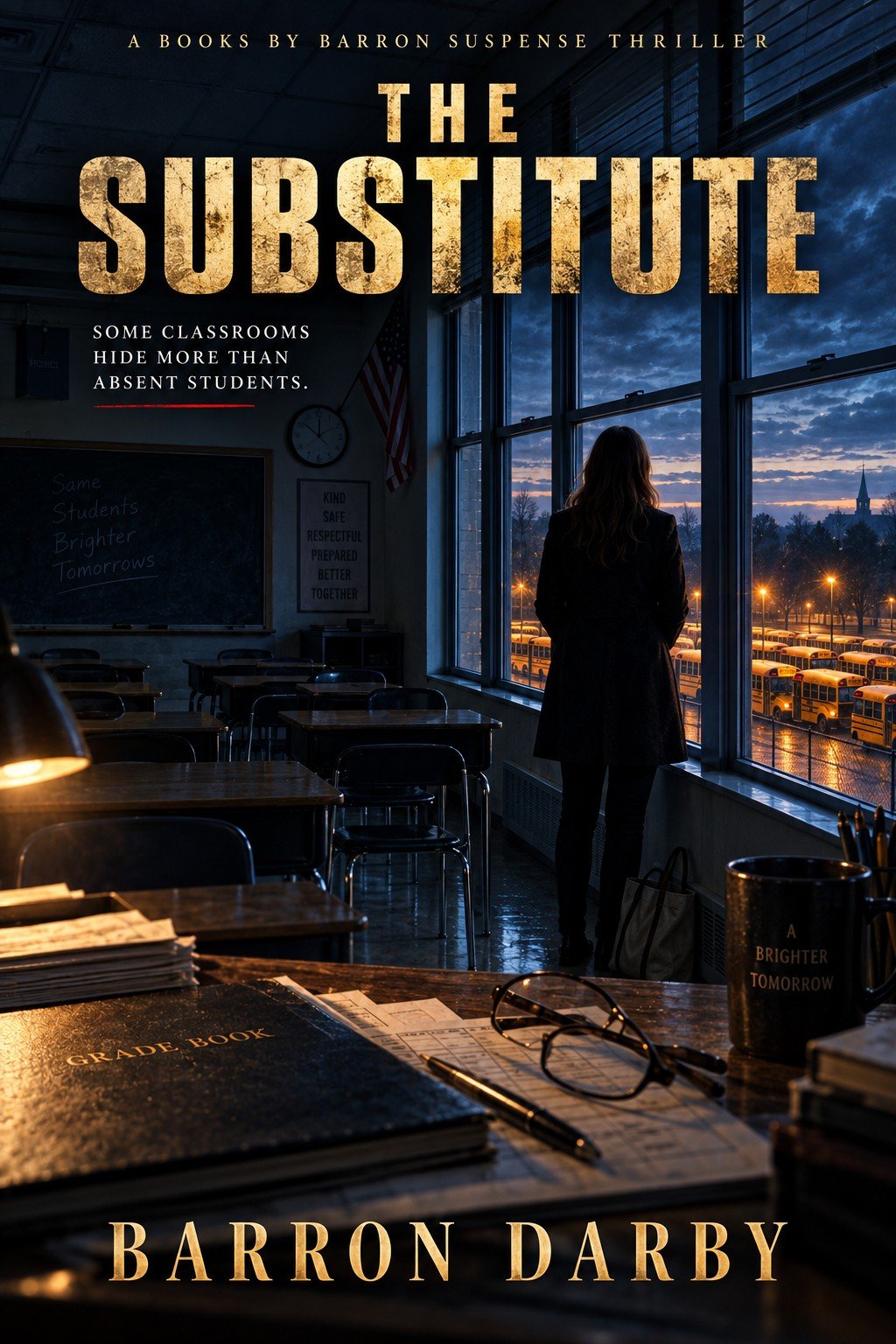
The Substitute
An Ohio Suspense Thriller
Written by Barron Darby
Paperback ISBN 979-8-953029-27-8 · Books By Barron
The callout system filled the vacancy at 5:41 in the morning, forty seconds after it opened and before it had dialled a single number.
A consolidated school district outside Columbus has been paying a substitute teacher who has worked all fourteen of its buildings, and not one of its fourteen principals can describe her. The licence on file belongs to a woman who died in Missouri in 2018, and the state of Ohio still lists it as active and current.
Dr. Thea Abernathy pulls the thread and finds it comes out through her own signature. Beverly Nowak, who has kept a second set of the sign-in sheets on carbon since the district system stopped agreeing with her hallway, is the only person in the county who can prove what happened. And the money was never the point: somebody has been putting one specific adult into specific buildings on specific days, and when the superintendent shuts the mechanism down, the woman signs into a building the following Tuesday anyway, on nobody’s payroll at all.
Chapter One
Chapter one is read by Jessica Anne Bogart. To keep reading, buy the Kindle edition on Amazon.
Did chapter one make you want chapter two?
This comes straight to me. No account, no purchase, nothing posted publicly.
The callout system filled the vacancy at 5:41 in the morning, forty seconds after it opened and before it had dialled a single number.
She saw it happen. She was standing at the counter in the dark front office of Fairlow Middle with her coat still on and her coffee still capped because the heat did not come up until six and the floor wax they had laid Friday was still curing and the smell of it sat in her sinuses like a coin. The monitor threw its blue across the countertop. She had opened the absence board to key in Marcy Kettleman’s sick day, and the slot for eighth grade science, period one through eight, was already green.
Assigned. 5:41 a.m. Corda, D.
Bev put her coffee down.
The system dialled. The whole design ran that way. It woke at 5:41 and worked a preference list in order, thirty seconds a name, and a good sub near the top could get three calls before her feet hit the floor.
It had not dialled anybody. The job log showed one line and the line was an assignment.
Marcy had opened the absence herself at 5:40 and twenty seconds, from her bathroom floor, on the app, which stamps to the second. Forty seconds later a substitute had the day.
Forty seconds is not a telephone call. Forty seconds is a hand already on it.
She stood there and did the arithmetic twice because she was fifty-eight and had learned that being right the first time was not the same as being able to prove a thing.
Then she went and got the binder.
The binders lived on the low shelf behind her chair, one per school year, and they were not district property in any sense the district would recognize. Bev had started them in the fall of 2021, the year the county went to the new absence platform and the reports stopped agreeing with the building. Every morning she printed the day’s sign-in sheet, and every afternoon at ten past three she took the sheet off the clipboard by the door, wrote the date across the top in her own hand, and slid it into the binder behind a sheet of carbon that gave her a second copy nobody else knew existed.
She pulled 2024 to 2025 and set it on the counter and went to March.
Her right ring finger did not straighten. It had not straightened since a bakery slicer at nineteen, and it made her turn pages with the flat of her hand, which slowed her down and had turned into a way of thinking. She turned to the eleventh. Then the twelfth.
March twelfth, 2025. Fairlow Middle. Building closed, boiler failure, staff and students released at 9:40 a.m., no afternoon session.
She remembered the day. Everybody remembered the day. The pipes had knocked like somebody was inside the wall with a wrench and Devon Mabry had walked the halls with his whistle lanyard swinging and his hands out flat, telling teachers to take their kids to the buses and stop asking him questions.
The sign-in sheet for March twelfth had seven names on it because seven people had signed in before the building emptied.
The eighth name was in the district system.
Corda, D. 7:12 a.m. Full day. Eighth grade science. Paid.
Bev looked at the sheet in the binder, and then at the screen, and then back at the sheet. What moved in her was not fear yet. It was the specific, narrow irritation of a woman who has kept a clean set of books for thirty-one years and has just been told by a machine that her books are wrong.
She got out her phone and photographed the page. She had photographed a lot of pages since 2021. She kept them in an album on her phone she had named Recipes, and she backed them up to a drive in a kitchen cabinet at home behind the roasting pans, and if anyone in the central office ever found out she did that, she would lose the pension she had twelve years left to earn.
She photographed it anyway.
Then she put the binder back. The front office lights came on all at once with their two-second stutter. The heat kicked. The first bus pulled into the lot with its lights making bars on the ceiling. Bev Nowak took the cap off her coffee and got ready to be pleasant to four hundred and ten children.
At 7:04 a woman came through the front door with a canvas bag on her shoulder and a knit headband pushed back off her forehead. “Good morning,” she said. “I am covering for Ms. Kettleman.”
Bev looked at her for a second and a half.
She was tall. Rangy. Brown hair pulled low, grey eyes, olive in the skin, a face you would have to describe twice because the first description would not be enough to pick her out of a lobby. Her clothes were good and looked new, a navy cardigan and grey trousers with the fold still faint at the knee.
She had a district badge clipped at her hip. Bev’s eyes went to it the way they went to every badge, out of thirty-one years of habit.
The corners were flat.
The laminator in the back room came off hot, and every badge Bev had ever printed had curled at the corners within a week, and she had complained about it in writing twice.
“Good morning,” Bev said. “Sign in on the clipboard, please.”
The woman signed. She had a small upright hand and she wrote D. Corda without a first name, the way people did when they had written it a great many times.
Bev watched her walk down the east hall toward 214.
Then she took the clipboard off the hook, though it was not ten past three, and photographed the top line.
* * *
The 6:40 meeting in the district boardroom had been on Thea Abernathy’s calendar for nine days and she had spent six of them not thinking about it, which was its own kind of discipline.
She parked at 6:12. The central office at Fairlow-Rowan shared a lot with the transportation building, an arrangement made in 2014 by people who had wanted the consolidation to look like one campus, and it meant that every morning of Thea’s working life started with the smell of diesel and the sound of forty-one engines turning over in sequence.
She went in through the transportation side because the coffee was better.
The dispatch window was a sliding pane of glass in a cinderblock wall with a shelf beneath. Roy Gladney had the window open and a route sheet spread on the shelf and a red pen in his hand. He looked up when her heels hit the concrete and gave her the smile he gave everybody.
“Morning, Doctor,” he said.
“Morning, Roy.”
She had learned his eyes in her first week, the way you learn a fact you are not supposed to mention. One blue, one hazel. He had told her about it himself before she could get embarrassed, the way he told everyone, in the first ninety seconds, so that it stopped being a fact anybody had to be careful around.
“Big day,” he said.
“Just an auditor.”
He tapped the route sheet with the pen. “I have been here twenty-two years,” he said. “I have never once seen an auditor come out at six forty in the morning for nothing.”
She laughed and took her coffee and went down the connecting corridor to the boardroom. By the time she was through the door she had forgotten she had spoken to him at all.
Randall Boyce was already at the table. He was thirty-eight and lean and he had set his canvas satchel on the floor beside his chair instead of on the table, which Thea noticed and liked. He had a laptop, one folder, and a mechanical pencil.
Len Szabo came in at 6:38 carrying his own coffee in a mug that said Treasurers Do It With Fund Balances, which he had been given as a joke in 2019 and had used every day since, and he sat down across from Thea rather than in the chair alongside.
Twenty-six months, and he still sat across.
“Doctor Abernathy,” Boyce said. “Thank you for the hour.”
“You picked it.”
“I did.” He opened the folder. “I picked it because I wanted the building quiet and I wanted your treasurer awake.”
Len snorted into the mug.
Thea sat. She put her hands flat on the table, the reading glasses pushed up into the crown braid where she kept them, and waited because she had learned in fifteen years that the person who fills the first silence in an audit meeting has already conceded something.
“The management letter goes out on the eleventh of September,” Boyce said. “Nothing in it is a finding for recovery. Nobody owes the state a dollar. I want that said out loud at the top because in my experience a superintendent who hears the word finding stops listening to the rest of the sentence.”
“I am listening.”
“It is a material weakness in internal control over payroll.” He turned the folder to face Thea. “Specifically, over the interface between absence management and payroll. And I want to walk you through why, because the why is not a number.”
Len set the mug down. “It is always a number.”
“Not this one.”
Boyce laid a single sheet on the table and turned it with two fingers.
It was a summary, one page, and Thea had seen three hundred pages of the same kind. Employee ID down the left. Buildings across the top. Paid days in the cells.
Fourteen columns. Fourteen buildings. Fairlow High, Fairlow Middle, Rowan Middle, Whitcomb, Rowan Elementary, Cannery Road, Tolliver, Dunmore, Pike Run, Bellemont, Sandhill, the Career Annex, the Early Learning Center, Second Street.
One row.
“E-40711,” Boyce said. “Two hundred and fourteen paid days across the last two school years. Two hundred and fourteen days in fourteen buildings.”
Thea put on her glasses.
She read the row twice. Bellemont, nineteen days. Pike Run, seven. Second Street, four. Sandhill, twenty-six. The numbers were small and ordinary and they were spread across every square foot of instructional space the district owned.
“That is a sub,” she said.
“That is a sub.”
“We have four hundred and sixty of them on the list.”
“You have four hundred and sixty on the list,” Boyce said, “and one hundred and ninety of them worked a day last year, and the median number of buildings any of them set foot in was two. The seventy-fifth percentile is three. There is one at four.” He tapped the sheet with the pencil, not the point, the eraser. “And then there is this.”
Len had come around the table without appearing to have decided anything. He put a finger on the row and moved it along.
“Twenty-eight thousand eight hundred and ninety dollars,” he said. “Over two years.”
“Correct.”
“That is not a fraud. That is a rounding error in my transportation fuel line.”
“I did not say fraud,” Boyce said. “I said control. The dollar amount is why it is a management letter and not a referral. The dollar amount is also the part that bothers me.” He closed the folder. “If somebody in this district wanted to steal, they would not steal twenty-eight thousand dollars in one hundred and thirty-five dollar increments over two years while showing up and working the day. It is the worst return on effort I have ever seen in a school district, and I have been doing this twelve years.”
The room was quiet. Somewhere under the floor a bus pulled out and the concrete carried the sound.
“Then what is it,” Thea said.
“That is not my question to answer. My scope is your controls.” Boyce picked the satchel up off the floor and set it on his knees. “But you asked, so I will tell you what I would do if I were you and I had two weeks before this letter is public. I would find out what the woman looks like.”
Thea took the glasses off.
“Say that again.”
“Nobody I spoke to could tell me what she looks like,” Boyce said.
He set the pencil down, which he had not done since he opened the folder.
“I do six of these a year and every one of them starts the same way. I take the largest exception in the population and I ask a warm-up question about it, because a warm-up question tells you whether the district knows its own business. So I asked six principals whether the name meant anything to them.” He opened the folder again and turned to a page of handwriting. “All six knew it. All six volunteered something. I did not push and I did not follow up, because I was not investigating anything, I was making conversation before I asked about journal entries.”
He read them out.
“Sandhill. Small blonde woman, terrific with the little ones. Whitcomb. Young, red hair, maybe a first year. Bellemont. She thought she was a retired teacher out of Union County, sixty if she was a day. Cannery Road. Heavy-set, dark, a green coat. Pike Run. Glasses, and nothing else. Tolliver.” Boyce looked up. “Tolliver told me she was certain the woman was a man named Corda who covered industrial tech, and then she thought about it for four seconds and said no, that is somebody else, and could not get back to it.”
Len Szabo said, “That is six people describing four hundred subs.”
“It is six people describing one. I filtered on the ID before I asked.” Boyce closed the folder. “Mr. Szabo, in twelve years I have never once had a district fail that question. It is not a hard question. Somebody always says, oh, she drives the little blue car.”
* * *
The principals’ meeting was Wednesday at eight in the Fairlow High library, and Thea had run it once a month for twenty-six months by an agenda she wrote herself and distributed the night before.
She did not distribute one.
Fourteen principals came in at ten of and got coffee from the urn and sat at the round tables the librarian set up for them. There was the particular loose noise of people who had cleared an hour and expected to spend forty minutes of it on transportation complaints.
Thea stood at the front with her hands behind her back.
“Good morning,” she said. “One item. I am going to say a name and then I am going to go around this room, and each of you is going to tell me what she looks like. Not whether she is good. What she looks like.”
Devon Mabry, at the third table, put his coffee down.
“D. Corda,” Thea said.
The nodding started before she finished the second syllable. Fourteen heads, all of them, at once.
“Sandhill.”
“Oh, she is wonderful,” said Ruth Ann Bellinger, who had run Sandhill Elementary since before the consolidation. “Little bitty thing. Blonde. She does the whole reading block without the folder.”
“Height.”
“Five two? Five three.”
“Cannery Road.”
“Taller than that,” said the Cannery Road principal, frowning at Ruth Ann and then at Thea. “Dark hair. Heavy-set. She wears the same green coat.”
“Whitcomb.”
“Red hair,” said Whitcomb. “Younger. Twenty-eight, thirty.”
“Pike Run.”
Pike Run said nothing for a moment. “I want to say glasses,” she said.
“That is not a description.”
“No,” Pike Run agreed. “It is not.”
Thea went all the way around the room. It took twelve minutes. She got a blonde, a brunette, a redhead, a woman in her twenties and a woman in her fifties, five foot two and five foot nine, heavy-set and slight, a green coat, a grey coat, no coat anybody could remember. Two of them described someone with a strong Appalachian accent. One described someone who barely spoke.
Every single one of them said she was good with the kids.
Thea went back to the top and started again.
“Sandhill.”
Ruth Ann Bellinger looked up with her coffee halfway to her mouth.
“I said blonde,” she said.
“You did.”
“I am going to have to take that back.” She set the cup down. “I said blonde because the reading block sub is blonde and I have had that woman in my building since the spring. But she is on the payroll under her own name and I signed her timesheet in April.” Ruth Ann’s face had gone the colour of the tablecloth. “Doctor Abernathy, I have been running that building for twenty-nine years and I have no idea which one of them I was describing to you thirty seconds ago.”
Nobody laughed.
Every single one of them said she was good with the kids.
“Devon,” Thea said last.
Mabry had not touched his coffee since she said the name. He turned the whistle lanyard once around his finger and let it go.
“I could not pick her out of this room,” he said.
“She has worked your building nine days.”
“I know how many days she has worked my building. I looked it up last night, because Bev Nowak came into my office yesterday afternoon and stood there until I opened the report.” He looked up. “Doctor Abernathy, I have seen her. I have said good morning to that woman. I know her voice. If you put six women in front of me right now, I could not tell you which one she is, and I have been trying since four o’clock this morning to work out how that is possible.”
Nobody in the library said anything at all.
“Her badge,” Mabry said. “Bev wanted me to tell you about the badge. The corners are flat.”
“Meaning what.”
“Meaning it was never printed in my building.” He spread his hands. “Or in any of theirs. Ours curl. All of ours curl. It has been in two work orders.”
Thea looked down the length of the library at fourteen people who ran fourteen buildings and were, all of them, waiting for her to explain it to them.
“Nobody says anything outside this room,” she said. “Not to your staff, not to your spouse, not on district email. Devon, I want Bev Nowak in my office at eleven and I want her to bring whatever she has been keeping.”
“She will want to know she is not in trouble.”
“Tell her she is the only person in this district who is not.”
Paperback ISBN 979-8-953029-27-8 · Books By Barron