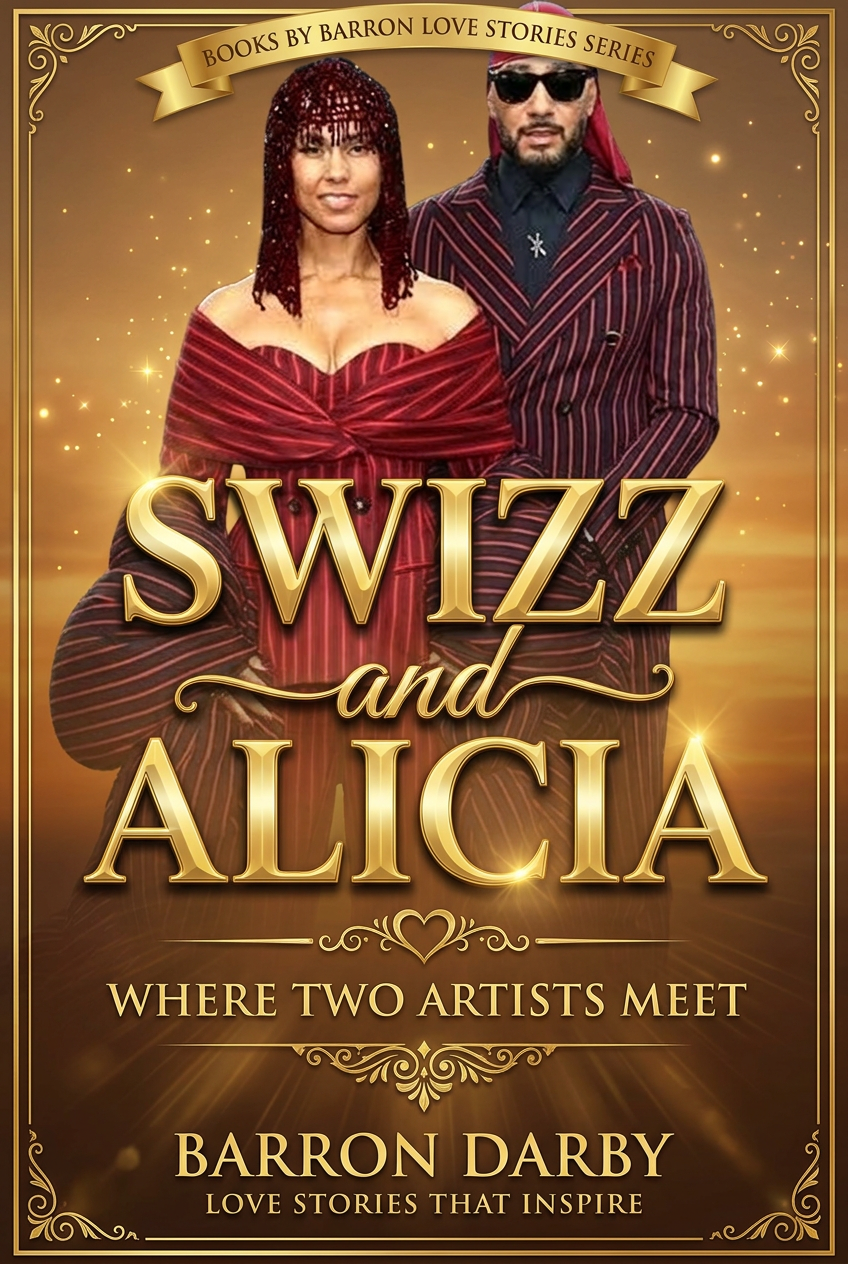
Chapter one is read by Jessica Anne Bogart. To read or listen to the whole book, buy the eBook and follow the reading and listening instructions beside the cover.
It is the morning of the thirty-first of July, two thousand twenty-six, on the back porch of a house above the Hudson in Englewood Cliffs, New Jersey, and a man who cannot sing a note is humming, badly, to a song his wife wrote, while she laughs at him from the kitchen.
There is a coffee mug warming on the kitchen counter. Two boys, fifteen and eleven, are arguing happily over cereal at the breakfast table. Through the kitchen window the river is silver. It is the couple's sixteenth wedding anniversary, and the celebration, so far, is the oldest joke in this house, which is that one of them can carry a tune and the other one absolutely cannot.
At the piano just off the kitchen sits the woman who married him in Corsica sixteen years ago. Her name is Alicia Keys. His name is Kasseem Dean, the world calls him Swizz Beatz. Between them they have more Grammys and platinum plaques than wall space, and a marriage they say, plainly, has not had a real argument in all sixteen years.
I will say what this book is. It is the story of a girl from Hell's Kitchen who plays the chord and a boy from the Bronx who is the laugh, who met young, met again grown, married on a Mediterranean beach, and built one big blended family out of music, art, and patience.
She is the chord. He is the laugh. He still cannot sing. The marriage came out beautifully anyway.
Before we begin, you should know how this book is built, because it is sung, if you will forgive the word, in two voices. One belongs to Alicia, the chord, the serious one, the one who chooses her words the way she chooses notes, carefully and on purpose. The other belongs to Kasseem, the laugh, the loud one, the one who talks with his hands and cannot tell a short story to save his life. We are going to take turns, chapter by chapter, the way we have taken turns at everything for sixteen years, one of us stepping forward while the other holds steady. When her version and his version of the same memory disagree, and they will, we have decided to leave the disagreement right there on the page, because that small, friendly arguing over what really happened is, when you get down to it, the actual sound of a marriage. So this is the chord and this is the laugh, telling you, between them, how two people who cannot do the same musical thing built a life entirely out of music anyway.
One more thing, before the two voices begin trading. People assume that two musicians must have fallen in love through music, that there was some duet, some studio moment, some song that brought us together. There was not, and we like to correct the assumption, because the truth is funnier and more honest. Music is the one thing we cannot actually do together. She plays and I cannot follow. I build beats and she cannot dance to them. The piano is hers, the turntables are mine, and when we try to meet in the middle, when I try to hum her melody or she tries to step to my rhythm, it is a small, loving disaster every time. What brought us together was never the music. It was everything around the music, the kitchen, the kids, the patience, the choosing. We are two of the most musical people alive who fell in love in all the unmusical, ordinary spaces, and that, we think, is exactly why it lasted.
We have noticed, over the years, that people want our love story to have a single dramatic turning point, the moment the music swelled and we knew. There was no such moment, and we have stopped apologizing for its absence. Our story is not a movie scene. It is an accumulation, a slow gathering of small recognitions over years, the kind of love that does not announce itself with fireworks but settles in quietly, like a key change you do not notice until you realize the whole song has shifted. The serious one will tell you she filed him under colleague and did not hear wedding bells. The loud one will tell you he went quiet around her before he understood why. Neither of us fell in a single instant, and we think that is the secret nobody wants to hear, that the most durable love is often the one that takes its time, that builds slowly enough to actually hold weight. Two people who were not ready became, over years, two people who were, and the patience of that becoming is the foundation the whole marriage stands on.
We should say, too, why we decided to tell this story at all, since we are private people about the things that count. We told it because the culture is starving for a different kind of love story than the one it keeps selling. The story everyone knows is the dramatic one, the passion, the fights, the breakups and makeups, the love that burns hot and flames out. We wanted to offer the other kind, the quiet, durable, undramatic kind, the love that does not make headlines because it never explodes, the marriage that lasts precisely because it refused the drama. It is not a flashy story. There is no betrayal in it, no scandalous turn, no public meltdown, and we know that makes it a harder story to sell. But we think it is the more useful one, the one a young couple actually needs to hear, and so we are telling it plainly, two ordinary-hearted people who happen to be famous, describing the unglamorous daily work that a lasting love is actually made of.
PART ONE.
Manhattan And The Bronx.
That is chapter one.
Follow the reading and listening instructions beside the cover to continue with the whole book.
BUY THE EBOOK · $3.99