
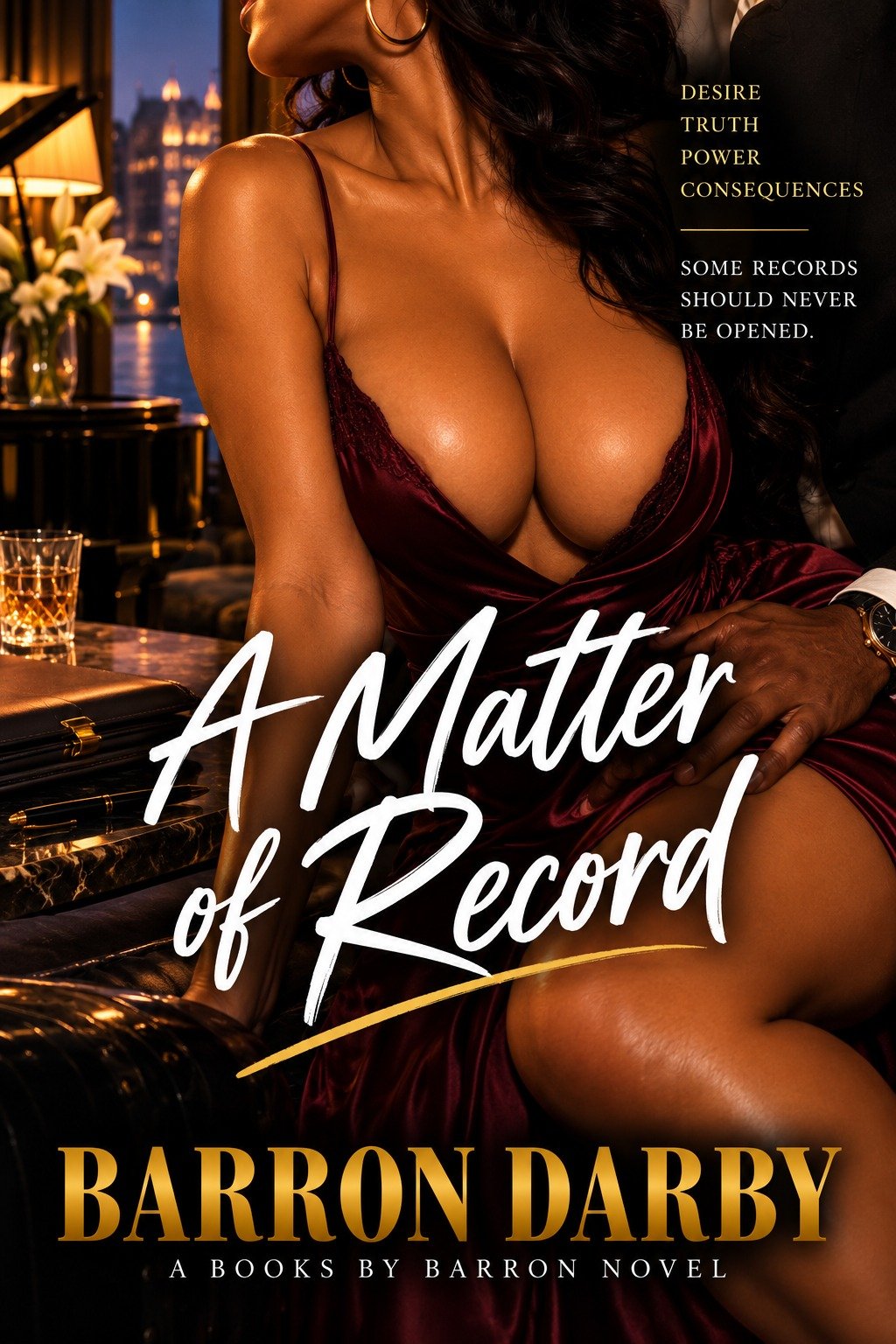
A Matter of Record
A Kansas City Erotic Thriller
Written by Barron Darby
Paperback ISBN 979-8-953029-01-8 · Books By Barron
Nobody in the room had asked the witness anything for eleven seconds, and Yolanda Merrick’s hands were still on the keys.
Yolanda Merrick is the most requested court reporter in the Sixteenth Circuit and has never had a page successfully challenged in thirty-one years. On a wet February afternoon she writes down a full sentence that nobody asked a question for. When counsel asks for a readback she leaves the line out, deliberately, in front of four lawyers, and hears herself do it.
It has happened ten times in nine years, in four counties, always in her hand, and nine of those ten people are dead.
Chapter One
Chapter one is read by Jessica Anne Bogart. To read or listen to the whole book, buy the eBook and follow the reading and listening instructions beside the cover.
Did chapter one make you want chapter two?
This comes straight to me. No account, no purchase, nothing posted publicly.
Nobody in the room had asked the witness anything for eleven seconds, and Yolanda Merrick’s hands were still on the keys.
She knew the count because the clock ran in her head the way a metronome runs in a drummer’s. Eleven seconds of a deposition is a long silence. It is a lawyer finding a page. It is a witness deciding how much of the truth to spend.
What it is not is testimony.
She looked at the strip of paper feeding up out of the tractor, at the last thing her fingers had put there, and the room tilted.
The line carried a name she had never heard in her life.
ANSWER. Merle Atchison. Sixteen years. Second shift out of Blue Springs.
She had not heard a question.
Rain came sideways off the Missouri and hit the eleventh floor windows in handfuls. Below, Grand Boulevard was a smear of taillights in the four o’clock dark. The conference room smelled of carpet glue and somebody’s cardamom gum. Seven people sat around a walnut table set for ten, and a pitcher of water sweated in the middle of it, untouched since ten in the morning.
The witness was Garland Moss, forty-four, Ridgeline Freight Systems’ director of fleet maintenance, a broad white man in a golf polo under a blazer, hands folded, a class ring on the right. He was drinking water. His eyes were on the middle distance of a man being paid by the hour to say nothing wrong.
Across from him, Chandra Prentiss had her reading glasses parked on top of her head where they lived, and she was writing on a legal pad, and she had not looked up.
Nobody had reacted.
Yolanda came off the keys. Set both hands in her lap. Looked at the line again.
The name belonged to no client, no case, no road she had ever written. It had come through her fingers with the shape of an answer, the little cadence of a man saying a thing he had said before, and her hands had put it down. Thirteen thousand pages a year for three decades. Her hands did not invent.
“Off the record for a second,” said Paulette Kehoe, for the defense, a thin white woman in grey with a French braid gone silver at the temple. She said it to the room, but she was looking at Prentiss.
Yolanda took her hands off the keys and put them in the air.
She raised them high, the way a woman with a cane had taught her in 1993, high enough that everyone at the table could see them, because the lifted hands were the whole contract. Off the record was not a legal state. It was a gesture. Four lawyers and a videographer relaxed at once at the sight of them. The room came apart into its parts. Kehoe said something about validating parking. Moss laughed at nothing. The young man behind the camera, Tobin Ashe, twenty-six, stretched his back.
At the north end of the walnut, Curtis Hoagland had not moved.
He was Ridgeline’s director of risk. He had the chair at the head of the walnut, with a legal pad squared to the edge in front of him, and in six hours he had not written on the pad. Navy suit off the rack and hemmed correctly. Flat blond crew cut going grey at the sides. A nose that had been broken and set by somebody in a hurry. He was turning a heavy class ring, thumb against the stone, and looking at the water pitcher.
“Back on the record,” Kehoe said.
Yolanda’s hands came down.
“Mr. Moss, the preventive maintenance interval on the tractor. Forty-five thousand miles or ninety days, whichever comes first. Is that the schedule in the manual or the schedule Ridgeline runs?”
“That is the schedule in the manual.”
“And the schedule Ridgeline runs.”
“That would be in the fleet records.”
“Take your time.”
Her fingers went. The sound of a steno machine is not typing. It is closer to a soft closing of doors, twenty-two keys under two hands, whole syllables at once, and Yolanda had never once in her life had to think. She wrote the way other people breathed.
“Can I get a readback,” Prentiss said. “The last answer and the one before.”
Here was the moment, and it came so quietly.
Yolanda scrolled her screen back. The lines were there, all of them, the questions and the answers in their columns, and there, sitting between Kehoe’s question about the tractor’s last inspection and Moss’s answer about the shop in Blue Springs, sat the line that belonged to no question.
It was still there. A name, a span of years, a shift and a terminal, in the answer column, in her own hand.
She could have read it aloud. That was the job. The job was to hold the room’s exact words in your hands and give them back without an opinion, and she had done it since 1994 without one successful challenge to a single page.
“‘QUESTION. And the last inspection on that tractor was recorded when,’” Yolanda read. Her voice came out flat and clean, the reader’s voice, no weather in it at all. “‘ANSWER. I would have to check the shop copy. QUESTION. The Blue Springs shop. ANSWER. Blue Springs, yes.’”
She stopped.
She heard herself stop, which was a thing she had never done before. There was a very small sound in the room that was her own throat, and nobody else heard it, because nobody in a deposition ever listens to the reporter.
“Thank you,” Prentiss said, and put her glasses down onto her nose and took them off again.
Kehoe asked the next question. Moss gave the next answer. The rain came across the glass in another handful. Yolanda’s hands went down onto the keys and did what they had always done. Behind her eyes the line sat in its column, black on white, exactly where she had left it. Unread, and left there on purpose.
She had just put something on the record that was not the record, by leaving something off.
Thirty-one years. Not once.
The machine at her knees was a Luminex, four years old, and behind the ports on the back of it, in a jack the size of a pencil lead, sat a microphone cable running to a black button on the table. The button sat on the long axis about two feet down from the head, which is where a reporter puts it to cover the witness and the questioner both. It had been recording since ten in the morning. It recorded everything the room said, and it stamped every fraction of a second of it to the exact stroke her fingers made, In three decades nobody had ever asked her for a second of it, because nobody had ever needed to check Yolanda Merrick.
That was the whole design. The audio was a net you only opened if the reporter fell.
“We can go off the record,” Kehoe said. “I think we are done for the day.”
Yolanda came up off the keys again.
She held both hands high, so everybody could see.
The clerk’s counter in Lafayette County was oak, waist high, worn pale in a half circle where ninety years of forearms had rested, and Emory Salk had his forearms in the worn place.
He had driven ninety minutes east in rain with the wipers on the slow setting, past the grain elevator at Napoleon, past a billboard for a fireworks barn that had been closed since he was in high school. The courthouse smelled of radiator dust. A space heater ran under the counter and cooked his shins.
“Two thousand nineteen,” he said. “March. Case number is on the card.”
He slid an index card across the oak. He wrote on index cards and banded them into decks. The deck in his messenger bag ran three inches thick, organized four ways.
The clerk was a young woman with a nose ring and a cardigan. She took the card and read it twice. “This is a deposition transcript, not a filing.”
“It was filed as an exhibit. Attachment C.”
“Huh.” She typed. “It was filed.”
Emory stood very still. He was six foot four and about a hundred and sixty pounds. Standing still was something he had learned on purpose. A tall thin man who fidgets makes a room nervous, and he needed rooms calm.
“Eighty-one pages at fifty cents,” she said. “Forty dollars and fifty cents. I can send it to your email.”
“Paper is fine.”
“Email is free.”
“Paper is fine.”
She looked at him then, properly, the way clerks do when a thing goes off the rails of its own procedure. Long red hair tucked behind both ears. Pressed oxford. Chinos with a crease. A face all cheekbone and freckle, and eyes that did not blink enough.
“Suit yourself,” she said.
He paid in cash. Two twenties and two quarters. He had the coins ready in his coat pocket, counted that morning, because a man who has to make change at a counter is a man the clerk remembers.
The copier ran on the other side of a partition. Emory looked at the bulletin board while it went. A flyer for a 4-H auction. A notice about jury parking. A missing dog with a phone number that had been torn off eleven times and had one tab left.
“Here you go.” She squared the stack and stapled the corner. Then she stopped, her palm flat over the staple. “That is funny.”
“What is funny.”
“Somebody ordered this last month.”
The space heater ticked. Emory made himself breathe out through his nose, slowly, the way you do when a doctor has the cold disc against your back.
“The same transcript.”
“Same case, same attachment. It sticks in my head because nobody ever wants Attachment C on anything.” She scrolled. “January twenty-ninth. Firm card, a place downtown.”
“Do you keep a name.”
“We keep the last four and the firm, that is all the machine gives me.” She squinted. “Prentiss and something. Vane.” She shrugged and pushed the stack toward him. “Maybe it was you.”
“It was not me.”
“Then it is a popular little file.”
Emory picked it up. Eighty-one pages, warm off the drum. The top sheet said IN THE CIRCUIT COURT OF LAFAYETTE COUNTY, STATE OF MISSOURI. Under that, a caption for a case about a culvert. Under that, the appearance page.
He did not read it at the counter. He put it in the messenger bag, thanked her, walked out into the rain. He sat in his car in the courthouse lot with the engine off and the windows going grey.
Then he read the appearance page.
APPEARANCES. For the Plaintiff. For the Defendant. And at the bottom, in the small type, the line that was the only reason he had driven ninety minutes for a file about a culvert.
ALSO PRESENT: Curtis Hoagland, Director of Risk, Ridgeline Freight Systems.
Emory took a fresh index card out of the bag. He wrote LAFAYETTE 3/19 and under it CH PRESENT and under that, in smaller letters, PRENTISS AND VANE 1/29.
He looked at that last line a long time.
For fourteen months he had believed he was the only man in Missouri laying these particular pieces of paper next to each other. He had built the belief carefully. He paid cash. He refused email. He used four counties and never the same clerk twice in a season, and he kept nothing on a computer, because he had learned in eleven years of paralegal work that everything on a computer is a subpoena away from somebody’s desk.
A plaintiff’s firm had been in Lafayette County a month ahead of him, pulling a filed exhibit out of a case about a culvert.
Either somebody at Prentiss and Vane was doing what he was doing.
Or somebody there had started down the same road for an entirely ordinary reason and would arrive without ever knowing what they had walked into.
He snapped the rubber band around the deck. It made a small flat sound in the car.
Then he started the engine, pulled out onto the wet street, drove west toward the city. He did not turn the radio on. He wanted to think, and the last time he had driven this road with music playing had been on the way to identify his sister.
Merrick Reporting had six rooms on the second floor of a brick building on Southwest Boulevard, above a tortilla factory that started its ovens at four in the morning, and at midnight the whole floor smelled faintly of corn.
In 2015 she had bought the building. She had twenty-two reporters on her roster and she staffed better than half the depositions taken in the Sixteenth Circuit, and the framed thing on the wall behind her desk was not a diploma. It was the first check she ever cashed as an owner, eight hundred and forty dollars, from a firm that no longer existed.
She still had her coat. She had come back for one thing.
The Luminex sat open on the desk with its cable running to her laptop. On the screen was the job file for the Moss deposition, seven hours and eleven minutes of it, the transcript in one pane and a waveform in the other.
Her reading glasses were in her hand. She had not opened them. She never wore them.
She found the line. It sat exactly where she had left it, black in its column, between an inspection and a shop in Blue Springs, and looking at it in her own office at midnight did not make it look any more like a mistake.
She put the cursor on the first word and pressed the key that says: play me the room at the moment my hands moved.
The office speakers were cheap. It did not matter.
Room tone came up first, the particular hush of a big carpeted box eleven floors above a wet street, the air handler, a chair creaking somewhere. Then a man’s voice, close and low and perfectly clear, at conversational volume, two feet from a microphone.
“Merle Atchison. Sixteen years. Second shift out of Blue Springs.”
Yolanda sat back.
She played it again. Then a third time, with the volume up, and then a fourth with the volume down, because the fourth time was to see whether she could still hear it when she was not trying.
She could.
It was not a hiss she was making into a sentence. It was not the building. It was a man in the room saying three short pieces of information the way you say them to a machine that is going to keep them for you, unhurried, no rise at the end, no one to answer.
She widened the window and played the sixty seconds on either side.
Kehoe: “Off the record for a second.”
Then the sound of a room letting go. Chairs. Somebody’s phone buzzing on wood. Kehoe saying something about parking validation and Moss laughing at nothing. Tobin Ashe’s equipment case snapping.
And under all of it, at the eleventh floor’s exact hush, four seconds of one man talking to the table.
Yolanda checked the timestamp.
15:42:07.
Then she checked it against her own strokes, which is what the software exists for, and then she had to sit down.
The strokes were there. Four of them, at 15:42:07, 15:42:08 and 15:42:09, in her hand, at her speed, clean.
And they sat inside a hole.
Paulette Kehoe had said off the record at 15:41:58. Yolanda had marked it the way she marked it four times a day, one stroke for the parenthetical, and from 15:41:58 to 15:42:19 there should have been nothing in that file at all. Twenty-one seconds of a room talking about parking, which is not testimony, which is not the record, which no reporter in America writes down.
There were four strokes in it.
She had raised her hands. She remembered raising them. She could see her own hands in the air in front of that table, high, the way a woman with a cane had taught her.
Her hands had come back down.
Not all the way. Not visibly. Fingers to the keys the way they rest between questions, because a reporter keeps her hands home so she can catch the instant counsel puts everybody back on, and Yolanda had kept her hands home for thirty-one years and had never once thought about what they were doing while she did it.
They had written what they heard.
That was the whole of it, and it was worse than a ghost. A ghost would have been outside her. This was the thing she had always been proudest of, running by itself, in a hole in the record, with nobody home.
She played the four seconds again and watched the stroke counter climb while the man was still talking, one twitch behind his mouth, the way a pen moves under dictation.
Yolanda put both palms flat on the desk.
Downstairs the ovens came on with a thump she felt in the floor, and the corn smell came up through the boards, and the radiator under the window began to tick.
Thirty-one years, and the one thing she had was that her page was the room. Not most of the room. Not the room as anybody remembered. The room. Judges had built rulings on her pages. A man was in Jefferson City on her pages.
The page was still the room. That was the trouble. The page was more of the room than the record was allowed to be, and she had put it there herself, four times a day, for three decades.
And she had already lied about it once today, out loud, in a readback, in front of four lawyers.
She reached over and stopped the playback. The waveform sat there in the dark of the screen with a small white line through it where the four seconds lived.
Then she did the thing that would keep her awake at three in the morning, looking at a ceiling.
She copied the whole job file. Audio, strokes, timestamps, the certified page and the raw notes under the page. She copied it onto a drive the size of a stick of gum, and she put the drive in the zip pocket of her purse, and she deleted nothing.
Deleting was for people who had done something. She had not done anything.
She had only failed to read one line aloud in a room where reading lines aloud was the entire content of her professional oath, and her hands had done it before she decided.
Follow the reading and listening instructions beside the cover to continue with the whole book.
Paperback ISBN 979-8-953029-01-8 · Books By Barron