
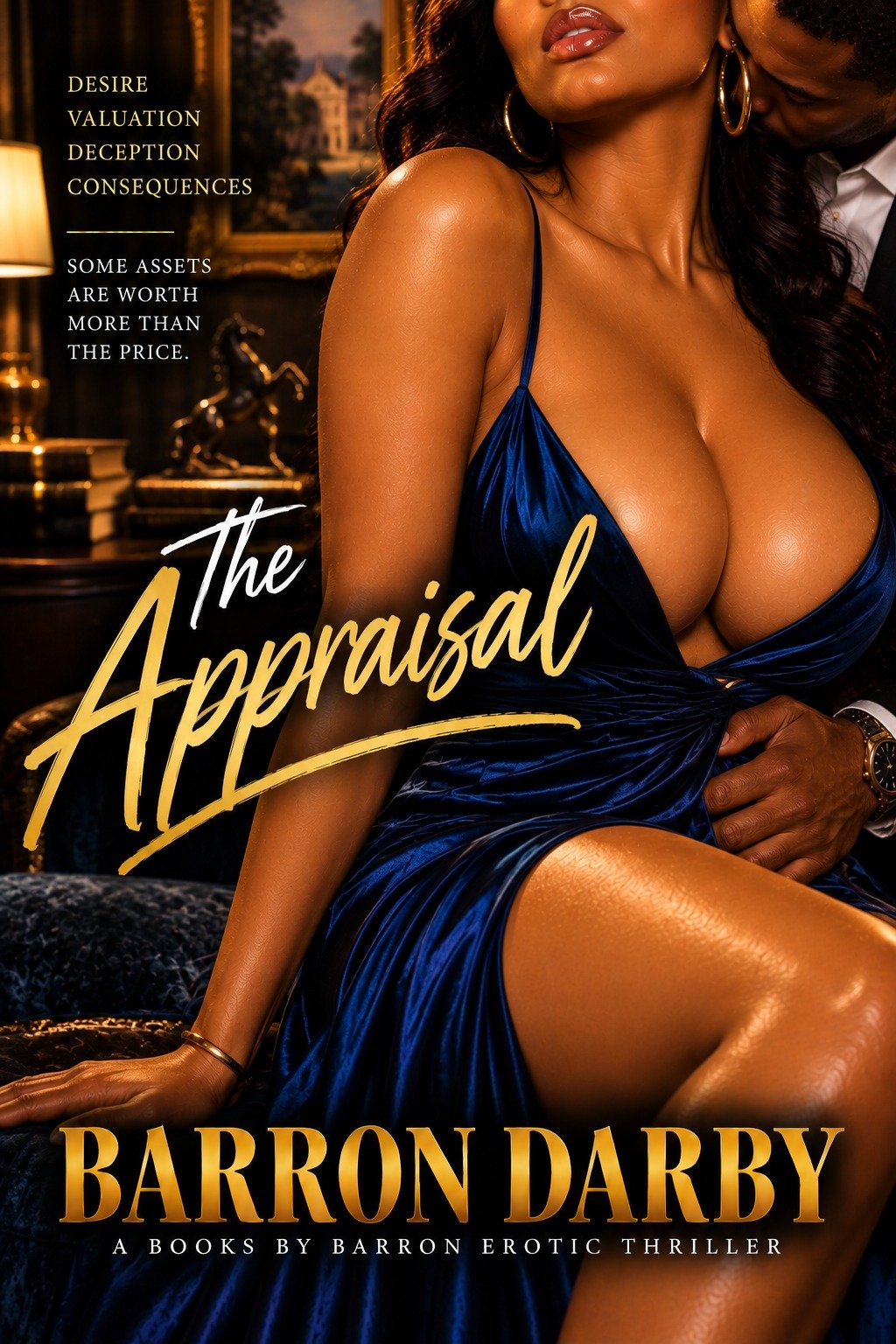
The Appraisal
A Philadelphia Erotic Thriller
Written by Barron Darby
Paperback ISBN 979-8-953029-05-6 · Books By Barron
A painting authenticated three times in forty years fails on the fourth, and every prior signature belongs to the same family.
It takes nine seconds. That is how long a conservation scientist holds a handheld instrument against the sky of a Hugh Treadway landscape in a basement in Philadelphia, three weeks before her museum closes a two hundred million dollar campaign. The spectrum says titanium, in a picture the file dates to 1911.
Doctor Hollis Ashby has been chief curator of the Meriwether for seventeen years. He signed the third authentication of that painting in 1998, when he was thirty, and it has been quoted in every appraisal of the object since.
Chapter One
Chapter one is read by Morgan. To read or listen to the whole book, buy the eBook and follow the reading and listening instructions beside the cover.
Shandiin Tsosie held the handheld against the sky in the upper left corner for nine seconds, and when the spectrum came up on the laptop Hollis Ashby heard himself say her name like a question.
“Doctor Tsosie.”
“I know.”
“Run it again.”
“I will run it again.” She did not move the instrument. “I will run it four more times in four other places first.”
The lab was in the basement on the north side, one long bench under a row of high windows that gave nothing in March but grey. The picture stood on a padded easel at the end of the bench with a strip of clean muslin under its feet. Twenty six by thirty six. A millrace in winter, black water in a stone channel, snow going blue in the shadow of the mill, three bare sycamores leaning out over the far bank. It was a beautiful thing. Ashby had said so in print in 1998 and had never had cause to take it back.
Through the glass in the door he could see two lawyers waiting in the corridor in their overcoats.
“Four more,” he said.
“Four more.”
She moved the handheld to the water. She held it there. The laptop drew its jagged line, a city skyline in green, and put the little labels above the peaks where the software thought they belonged.
Lead. Zinc. Iron. Titanium.
“Sky, water, snow, the trunk of the middle tree, and the sleeve of the man on the footbridge,” Shandiin said. “Five passages, five different colours, five different depths of paint. If it were a retouch it would be in one of them.”
It was in all five.
Ashby put his hands in his pockets to stop the left one. He had a pen in that pocket for exactly this reason and he closed his fingers around the barrel. The tremor had come on eleven years ago and it was nothing, a benign thing with a long dull name, and it had never once been visible in a room where it mattered.
“Titanium white,” he said.
“Titanium is what the machine sees. Titanium white is the argument you and I are about to have.” She straightened and pushed the headband magnifier further up her forehead, where it lived. “The instrument tells me an element is present. It cannot name the compound. It cannot name the layer. It has no opinion. That is the whole reason people trust the machine.”
“The file says 1911.”
“I read the file.”
“Titanium white in an artists’ colour is 1925 at the earliest. Bourgeois, in Paris.” He had said the same thing to four hundred graduate students. “Winsor and Newton in 1928. Nobody in Chadds Ford in 1911 has a tube of it, because no such tube exists yet.”
“That is what the machine gives me,” Shandiin said. “And I have it in five places.”
Out in the corridor, one of the lawyers looked at his watch.
The fourth authentication of “The Millrace, Winter” had been put on the calendar in November as a formality. Nobody had wanted the job. The Second Century Campaign had a gala on the eleventh of April and a hard number on it, and somewhere in the machinery of a two hundred million dollar ask a foundation officer had asked, in writing, whether the collection’s headline gifts had current documentation. The word current had done all the damage. Three authentications existed. The most recent had been signed in 1998. So the museum had scheduled a fourth, and had put it in the hands of the conservation scientist it had hired eighteen months ago precisely because she was better than anyone it could afford.
Ashby had signed the requisition himself. He remembered thinking that it would take an afternoon.
“Show me the sky again,” he said.
She showed him the sky again. The peak stood up out of the baseline like a finger.
“How confident are you.”
“On the element, completely. It is not noise and it is not the easel and it is not my hands.” She lined up the first of her turquoise cuffs on the bench, then the second, then the third, the way she did before she touched anything that mattered. “On what it means, I am at the beginning. There are two titanium whites, Doctor Ashby. Anatase and rutile. Anatase is 1923 in France, after 1926 here. Rutile is 1938. If this is anatase I can tell you the picture is not from 1911 and it might be from 1926. If it is rutile I can tell you it is not from 1911 and it cannot be from before 1938.”
“Treadway died in 1951.”
“Then rutile still leaves him thirteen years.”
“It would let him paint it at seventy,” Ashby said, “in the last decade of a career the market does not want, on a canvas that the file says he made at forty three at the top of his powers, in the year that every exhibition history in Philadelphia assigns to the picture.” He heard his own voice go up and brought it down. “Which one do I have.”
“XRF cannot tell you. I need Raman, and for Raman I want a sample, and for a sample I need a form signed by you and a second signature from the registrar.”
“Then get the form.”
“I will get the form.” She stopped. “There is a version of the next four weeks where I get the form on the twelfth of April instead.”
He did not answer.
She had said it plainly and without any weight on it, which was worse. She had given him the door and stepped back from it so he could see the whole frame.
Ashby walked down the bench to the picture.
He had a loupe on a black cord around his neck. He had worn it every working day since 1989 and he wore it now, and he did not lift it, and he stood at a polite distance from the surface with his hands behind his back like a visitor. The mill was on the left. The race came diagonally out of it toward the viewer, black and quick. In the middle distance a man in a brown coat crossed a plank footbridge with his shoulders up against the cold.
He had written eleven hundred words about that man in brown in 1998.
“Doctor Tsosie.”
“Yes.”
“Hold the report for a week.”
The laboratory made the small sounds laboratories make. The extractor over the fume hood. The compressor under the bench.
“Say the rest of it,” she said.
“There is no rest.”
“There is always a rest. A week for what.”
“A week so that I can look at the object file, and the exhibition record, and the two other Treadways in this building, before I put a document into the world that will be read by people who will not read the second paragraph.” He turned around. “You have five readings from one instrument, taken this morning, on a picture nobody has questioned in sixty eight years. That is not a finding. That is a reason to work.”
“It is a finding. It is a small one.” She was not angry. She was doing the thing she did, which was to stand still and be exactly as correct as she had been thirty seconds earlier. “But I will hold it for a week.”
“Thank you.”
“I want you to notice that you asked.”
Ashby went out past the lawyers without stopping. He got as far as the stairwell before it arrived.
He had come down here this morning intending to be helpful and slightly bored. He had a docent lunch at one. He had a call with a dealer in London at four. He had, in the leather folder under his arm, the object file for accession 1998.44, which he had signed out of the vault at eight and had not yet opened, and he opened it now on the landing with his back against the cinder block.
Three letters. Sixty eight years of paper in a folder soft at the corners.
1958. 1979. 1998.
The third one was two pages on Meriwether letterhead. His own name at the bottom in his own hand, the loops smaller then, the H harder. Twenty fourth of February, 1998.
He read the first page and his eyes went across the sentences without taking any of them in, the way you read a thing you wrote when you were thirty.
Then he stopped.
He could not remember the room.
He could remember the letter. He could remember the argument in it, the passage about the handling of the water, the comparison to the Coatesville pictures. He could remember typing the pages. He could not remember standing in front of the painting. Not the light on it, not the wall it was on, not the smell of whatever building it had been in, not one single physical fact of the eleven minutes he must have spent in its presence.
He had spent a working life in front of nine thousand paintings. He remembered rooms the way other people remembered songs.
Ashby closed the folder and stood on the landing with the fire door humming beside him, and above the sound of it he could hear, very faintly, four floors up and a hundred feet away, the sound of Tess Mallory Keen’s bangles coming along the marble.
The docent lunch was at one in the members’ room and there were nineteen of them, which was a good turnout for March.
He gave them twenty minutes on the spring rotation and took questions for fifteen, and he was fine, and then a retired pharmacist named Ruth Ganz put her hand halfway up and asked about the Treadway.
“The one in the corridor by the coat check,” she said. “The winter one with the little man on the bridge. A visitor asked me last Sunday how they knew it was really by him and I gave her an answer and I have been unhappy with it all week.”
“And what did you tell the visitor.”
“I told her that the museum had experts.”
Nineteen faces waited.
Hollis Ashby had answered this question in some form four hundred times, in this room and in eleven others, and he had an answer he liked, and it was true, and he had never once had to think before he said the words.
“That is the answer most people get,” he said, “and it is not a good one, so let me give you the real one and you can use it on Sunday.”
Ruth Ganz took out a small notebook, which delighted him and made everything worse.
“Attribution is three things,” he said. “The first is the eye, which is the least reliable and the most romantic. Somebody who has looked at four hundred pictures by a painter can usually tell you when a fifth is wrong, and cannot always tell you why, and is wrong themselves about one time in twenty. The second is the paper. Where the picture has been, who owned it, when it was exhibited, what it sold for in 1931. We call that provenance and it is the part that lawyers like.”
“And the third,” Ruth said.
“The third is the object itself. The fabric of the canvas. What is in the paint. Whether the ground is what the painter used in that decade. That is the only one of the three that cannot lie to you, and it is the newest, and for most of the history of this profession nobody had it at all.”
“So the third one settles the matter.”
“The third one settles the matter.”
“Then why do we need the other two.”
The members’ room had a radiator under the window that knocked twice an hour and it knocked now, and Ashby heard himself pause on it, and knew that at least four people in the room noticed him pause.
“Because the third one is expensive,” he said, “and the first two are free.”
They laughed. It was a good line. He had never said it before in his life and he understood as it came out of his mouth that he would never say it again.
Afterward, walking back along the corridor by the coat check, he stopped in front of the empty place on the wall where the picture had hung until Tuesday, and looked at the four brass hooks and the rectangle of paint the frame had kept from fading.
Ruth Ganz caught up with him with her coat over her arm.
“You did not answer the question,” she said.
“I answered the question you asked.”
“You did indeed.” She smiled at him with great kindness, which was unbearable. “You have a wonderful way of doing that, Doctor Ashby. I have been coming here since 1994.”
Shandiin waited until the lab was empty and the lawyers had gone and the building had done the thing it did at six, which was to sigh once through its ductwork and drop three degrees.
Then she went and got another picture.
The bequest storage room was two doors down, a windowless space with a screen rack that pulled out on rails and a shelf of unglazed stoneware nobody had accessioned properly since the eighties. Twelve Lamontagne Treadways lived in the building. Six were on the rack. She pulled bay four.
“The Narrows,” 2024. Nine feet of nothing much: a river, a gorge, two figures small enough to be punctuation. The museum had taken it sixteen months ago with a press release and a dinner.
She carried it to the bench on a padded trolley, alone, which was against the handling policy she herself had written, and she set it on the easel and left the overhead off. The bench lamp was enough.
She ran the handheld on the sky.
Lead. Zinc. Iron. Titanium.
Same passage. Same corner. Same nine seconds.
She sat down on the stool.
“The Narrows” was dated 1913 on its label and in its file and on the wall text that had hung under it for six weeks in the spring of 2025. Two years after “The Millrace, Winter.” Same painter. Same decade. Same donor family.
Same anomaly.
There was a version of tonight where she stopped, and wrote both of them up, and put the paper on Ashby’s desk in the morning. She had done that once, at thirty one, at an institution she no longer named in conversation, and she had been correct, and eleven weeks later she had been moved to a department where the most interesting object was a chair.
So she did not stop.
She pulled bay one, bay two, bay five. Then she went down into the sub basement with a key she was supposed to sign out and did not. In the long room, where the racks still had no numbers painted on them, she found four more.
By half past eleven she had run eight.
Eight Treadways, eight skies, eight spectra saved to her own drive under a folder she named with a date and nothing else. Nine, counting the one Ashby had watched her run that morning. Titanium in all of them. She checked her instrument against a certified standard twice, once at the start and once at the end, and the standard came back where it should both times.
She lined up her bracelets and looked at them.
The thing about nine was that one was an error and two was a coincidence and nine was a practice.
Eight of them were hers alone.
She wrote a single line in her notebook, which she kept in pencil because ink lies about its own age.
Nine of twelve. Same passage, same corner, same hand.
Then she added the part she did not like.
The hand is not the painter’s.
Tess Mallory Keen’s office was on the fourth floor at the corner, and you heard her before you saw her, and she had never in her life apologised for the noise.
“Hollis.” She came around the desk with both hands out and took one of his, which she did to everyone and which everyone liked. “Sit down. You look like a man who has been in a basement.”
“I have been in a basement.”
“Was it interesting.”
He sat. The office had two windows on the quad and a third that looked down the length of the west corridor at the donor wall, which Ashby had always assumed was an accident of the architecture and had recently begun to suspect was deliberate.
“Tess, how long is left.”
“Twenty three days.” She did not have to think. “The gala is Saturday the eleventh. We are at a hundred and seventy nine point two as of this morning, we have four asks outstanding that I would put at eleven million combined, and the Lamontagne match closes the rest of it if it closes at all.” She sat down on the front edge of the desk instead of behind the blotter. The bangles settled. “Why.”
“The fourth authentication came back strange.”
He watched her face and got nothing from it, which was normal. Tess had a face for donors and a face for trustees and a third one she used in the building, and the third one was pleasant and gave nothing away and had been doing that since before he was chief curator.
“Strange how.”
“Doctor Tsosie found titanium in the paint. In five passages. In a picture the file dates to 1911.”
“And titanium is a problem.”
“Titanium white does not exist as an artist’s material until the middle of the twenties.”
“So the file is wrong about the year.”
“The file is not wrong about the year in the way you mean,” Ashby said. “The year is the picture. The exhibition history is attached to the year. The 1958 letter is attached to the exhibition history. The valuation is attached to the letter. You cannot move the year six inches without everything above it coming down.”
Tess was quiet for a moment. Behind her the light was going off the quad and the lamps had come on along the path.
“Who else knows.”
“Doctor Tsosie. Two lawyers who were in the corridor and heard nothing. Me.”
“Not Darius.”
“Not yet.”
“Not Audra.”
“Not yet.”
“All right.” She stood up and walked to the third window, the one that faced the donor wall, and she stood with her back to him. “I want to say something and I want you to let me finish before you decide what I said.”
“Please.”
“We can move the gala.”
Ashby said nothing.
“Not far. The eighteenth. We lose the Kimmel date and we pay for it and it is a headache for eleven people including me, but it is a week, and a week is a very long time when you need one.” She turned around. “I can have the venue on the phone in nine minutes.”
“Tess.”
“You said twenty three days like a man who wants more of them.”
“I did not tell you there was a problem,” Ashby said. “I told you a test came back strange. You have offered to move a two hundred million dollar campaign event before I finished the sentence.”
The bangles did not move. He noticed that, and could not place why it mattered. Her hands were down at her sides and perfectly still, which he had not seen before, in eleven years of standing next to her at openings.
“Hollis,” she said, and her voice was kind, “you came up four floors to tell me. If it were nothing you would have emailed me from the basement.”
Which was true. Which was completely true.
“I do not want the gala moved,” he said. “I want a week and a Raman spectrometer.”
“Then have both.”
“I need a sampling authorisation signed by the registrar.”
“Darius will sign anything you put in front of him. He likes you.” She came back around the desk and this time she went behind it, and she pulled her chair in, and the meeting was over in the way her meetings ended, which was that the room simply stopped being about you. “Hollis. One thing.”
“Yes.”
“When you do write it up. Whatever it says.” She looked at him. “Bring it to me before you bring it to Audra.”
Ashby went down the stairs instead of the elevator.
The west corridor at that hour was empty and lit from the floor, and the limestone panels went up out of the light into the dark of the ceiling. Names cut half an inch deep. He had walked past them four thousand times.
LAMONTAGNE was on the third panel, at the top, in the largest size the mason used.
He stopped in front of it, which he had never once done, and he thought about a fax machine.
He could not have said why. It came into his head whole: the grey plastic thing on the credenza in the office he had in 1998, and the sound it made when it woke up in the middle of the night, and the way the paper came out warm and curled.
He had been in Basel in February of 1998.
He was almost sure.
To read or listen to the whole book, buy the eBook and follow the reading and listening instructions beside the cover.
Paperback ISBN 979-8-953029-05-6 · Books By Barron
Paperback ISBN 979-8-953029-05-6 · Books By Barron